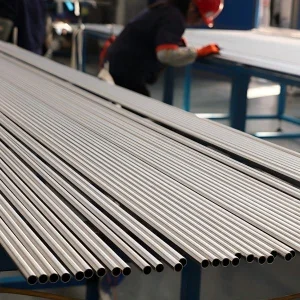
Precision ASME & ASTM TIG Welded Tube Selection
Explore our premium grade austenitic stainless steel and titanium tubing engineered for critical thermal transfer, chemical processing, and sanitary operations.








Metallurgical Mechanics of TIG (GTAW) Welded Stainless Steel Tubing
Tungsten Inert Gas (TIG) welding, technically referred to as Gas Tungsten Arc Welding (GTAW), stands as the golden standard process for high-integrity stainless steel tube manufacturing. Unlike high-frequency resistance welding (HFRW) or laser welding, TIG welding utilizes a non-consumable tungsten electrode surrounded by a continuous stream of inert shielding gas (typically high-purity Argon or Argon-Hydrogen mixtures) to form an autogenous fusion seam. This process preserves the intrinsic alloying elements—such as Chromium, Nickel, Molybdenum, and Titanium—preventing oxidation and elemental burn-off within the molten weld pool.
Heat-Affected Zone (HAZ) Optimization
Precision control of heat input during GTAW limits the width of the Heat-Affected Zone (HAZ), mitigating carbide precipitation along grain boundaries (chromium carbide formation between 450°C and 850°C). This ensures maximum intergranular corrosion resistance in aggressive chemical environments.
Inner Bead Roll Conditioning
Following autogenous TIG welding, the internal weld bead undergoes continuous cold working via hydraulic inner bead rolling or mandrel drawing. This homogenizes the weld structure, flattens the internal bead profile (Ra < 0.4 µm), and eliminates fluid flow turbulence or bacterial entrapment zones.
Full Solution Annealing
All high-performance TIG welded stainless tubes undergo inline or off-line solution annealing under protective atmosphere (Bright Annealing) at temperatures ranging from 1040°C to 1150°C followed by rapid cooling. This dissolves segregations, restores austenitic phase balance, and relieves internal mechanical stress.
Industry Trends Shaping the TIG Welded Stainless Tubing Market
The global demand for high-grade TIG welded stainless steel tubing is experiencing a technological evolution driven by energy transition, ultra-pure processing requirements, and automated smart manufacturing. Below are the key engineering vectors transforming production and material requirements:
1. Transition to Automated Multi-Cathode Orbital TIG Systems
Traditional single-torch TIG lines are being replaced by high-speed multi-cathode orbital TIG welding stations. By staging multiple electrodes in series (pre-heat torch, fusion torch, and smoothing torch), manufacturers achieve up to 300% faster production speeds while maintaining optimal linear heat input, preventing grain coarsening in super-austenitic (e.g., 904L, 254SMO) and duplex grades.
2. Hydrogen Infrastructure & Clean Energy Decarbonization
With global green hydrogen initiatives expanding, TIG welded 316/316L and 317L tubes with low residual ferrite (FN < 0.5) are replacing standard seamless pipes in medium-pressure hydrogen transport lines. TIG welded tubes provide superior wall thickness concentricity (±5%), preventing hydrogen embrittlement nucleation points caused by uneven wall stress distribution.
3. Real-Time Vision & Acoustic Arc Monitoring
Modern smart TIG tube mills integrate AI-assisted optical vision and acoustic sensor arrays. By evaluating the spectral frequency of the welding arc and capturing real-time molten pool geometry, automated feedback loops adjust welding current and shielding gas flow dynamically, eliminating micro-porosity and undercut risks during high-speed runs.
4. Substitution of Seamless Tubing with Cold Drawn TIG (W&D)
Advancements in cold drawing and seam-homogenization have elevated Welded & Drawn (W&D) TIG tubes under ASTM A249 / ASTM A269 to perform at mechanical parity with seamless tubes (ASTM A213). Global EPC contractors are increasingly specifying W&D TIG tubes for heat exchangers due to their 20–30% cost savings, superior wall tolerance, and flawless internal concentricity.
Global Enterprise Sourcing: Critical Challenges & Engineered Solutions
Procurement teams sourcing TIG welded stainless steel tubes for high-consequence projects face complex technical requirements regarding quality assurance, compliance, and supply chain continuity. Below is how top-tier manufacturers solve key enterprise procurement pain points:
| Procurement Challenge | Technical Root Cause | Industry Standard Risk | Spezilla Enterprise Solution |
|---|---|---|---|
| Pitting & SCC Failure in Service | Incomplete fusion seam, poor gas shielding causing internal oxidation or chromium depletion. | Premature tube rupture, fluid leakage, expensive plant shutdowns. | 100% Argon-Hydrogen backing purge with zero-oxygen internal monitoring; post-weld solution annealing at 1080°C. |
| Wall Thickness Eccentricity | Variations in coil strip raw material or improper forming die alignment. | Uneven heat transfer in heat exchangers, localized pressure drop, bursting under hydrostatic load. | Precision cold-roll forming with tight strip tolerance control (±0.02mm); continuous ultrasonic thickness monitoring. |
| Counterfeit / Subpar MTC Documentation | Lack of heat traceability from raw mill heat numbers to final bundle delivery. | Rejection during TPI (Third-Party Inspection), failure to comply with ASME Sec VIII or PED 2014/68/EU. | Complete heat trace code etched on every single tube length; EN 10204 3.1 / 3.2 certification validated by TÜV or Lloyd's. |
| Bending & Flaring Fractures | Excessive residual weld stress or un-annealed martensitic transformations in HAZ. | Tubes cracking during U-bending, tube-to-tubesheet expanding, or orbital field welding. | Fully recrystallized austenitic micro-structure achieved via inline induction heat treatment; 100% flare and flattening tested per ASTM A1016. |
| Microbial & Particulate Entrapment | Rough internal weld bead profile (Ra > 0.8 µm) in sanitary and pharma tubing. | Contamination in bio-processing, clean steam line erosion, batch loss in food/beverage plants. | Internal bead flattening rolling followed by mechanical polishing (up to 800 Grit) and electropolishing (Ra < 0.25 µm). |
Procurement Assurance Tip: Verifying Weld Seam Integrity
When reviewing Material Test Certificates (MTCs) for TIG welded exchanger tubes under ASTM A249, ensure that non-destructive testing includes both Eddy Current Examination (ASTM E426) and an air-under-water / hydrostatic test. Furthermore, mechanical testing must state flatten, flange, and reverse bend test results to confirm complete weld ductile integrity.
Macro Industry Solutions Powered by Precision TIG Tubing
Tailored metallurgical formulations and precision dimensional tolerances allow TIG welded stainless tubing to serve across diverse high-stress industrial applications:
Chemical & Petrochemical Processing
Primary Grades: ASME SA213 / SA312 TP316L, TP316Ti, TP347, TP310H.
Engineered to withstand organic and inorganic acid streams, high-sulfur hydrocarbons, and elevated operating temperatures up to 800°C. Titanium-stabilized grades (TP321H, TP316Ti) prevent intergranular sensitization under continuous thermal cycling.
Thermal Power & Nuclear Heat Exchangers
Primary Grades: SA213 TP304H, TP316H, Super Duplex UNS S32750.
Utilized in feedwater heaters, surface condensers, and boiler superheater elements. High-creep-strength austenitic alloys with controlled carbon content ensure long-term mechanical reliability under elevated steam pressure environments.
Biopharmaceutical & Ultra-Pure Utilities
Primary Grades: ASTM A270 TP316L (ASME BPE Compliant).
Featuring ultra-smooth bore finishes (Ra < 0.375 µm EP), sulfur-controlled chemistry (0.005%–0.017%) for orbital field weldability, and strict cleanroom packaging to guarantee sterile fluid handling in WFI (Water for Injection) systems.
Marine, Desalination & Offshore Systems
Primary Grades: Titanium Gr. 2 (UNS R50400), Gr. 3, UNS S31803 / S32205.
Immune to chloride ion pitting, crevice corrosion, and erosion in high-velocity seawater cooling units. Titanium and Super Duplex TIG tubing eliminate marine fouling vulnerabilities in offshore platforms.
Automotive Exhaust & EGR Coolers
Primary Grades: Ferritic SS 405 (UNS S40500 / 1.4002), 439, 444.
Low thermal expansion, high thermal conductivity, and resistance to cyclic oxidation. Ferritic TIG tubes provide exceptional vibration resistance and cost stability in OEM exhaust systems.
Food, Dairy & Beverage Sanitary Processing
Primary Grades: ASTM A270 / EN 10357 TP304L, TP316L.
Non-toxic, easy-to-clean sanitary tubing featuring polished OD/ID surfaces, fully compliant with 3-A Sanitary Standards and FDA sanitary requirements for milk, beer, and juice transport.
Global Standards Compliance & Quality Assurance Framework
To ensure seamless international deployment, all TIG welded stainless steel and titanium tubes are manufactured, tested, and certified in accordance with global pressure equipment codes and metallurgical standard specifications:
International Material & Product Standards
-
ASTM A249 / ASME SA249: Standard specification for Welded Austenitic Steel Boiler, Superheater, Heat-Exchanger, and Condenser Tubes.
-
ASTM A269 / A269M: Standard specification for Seamless and Welded Austenitic Stainless Steel Tubing for General Service.
-
ASTM A312 / ASME SA312: Standard specification for Seamless, Welded, and Heavily Cold Worked Austenitic Stainless Steel Pipes.
-
EN 10217-7: European standard for Welded Steel Tubes for Pressure Purposes — Stainless Steel Tubes.
-
ASTM B338 / SB338: Standard specification for Seamless and Welded Titanium and Titanium Alloy Tubes for Condensers and Heat Exchangers.
Rigorous Quality Control & Inspection Protocols
-
Non-Destructive Testing (NDT): 100% inline Eddy Current Testing (ASTM E426 / EN ISO 10893-2) combined with Hydrostatic Testing (up to 20 MPa) or Pneumatic Air-Under-Water Testing.
-
Destructive Mechanical Testing: Tensile, Yield, Elongation, Flattening, Reverse Flattening, Flange, Hardness (HRB/HV), and Intergranular Corrosion Testing (ASTM A262 Practice E).
-
Regulatory Approvals: PED 2014/68/EU (Pressure Equipment Directive), AD 2000-Merkblatt W0, ISO 9001:2015 Quality Management.
-
Mill Test Certification: Issued strictly to EN 10204 3.1; EN 10204 3.2 TPI (SGS, TÜV, BV, DNV, Lloyd's Register) available upon request.
Technical Roadmap: Next-Generation Tubing Innovations
Looking toward 2030, the precision stainless tubing industry is advancing along three critical technology fronts: hybrid laser-TIG processes, digital twin quality tracking, and specialized alloy development for extreme operational environments.
Hybrid Laser-TIG Welding Technology
Combining the deep penetration of fiber lasers with the arc stability and smooth surface crown of TIG welding. Hybrid Laser-TIG reduces total heat input by 40%, enables single-pass welding of heavy wall tubes (WT > 4.0 mm), and practically eliminates grain growth in heat-sensitive alloys.
Digital Twin & Blockchain Traceability
Full digitization of the manufacturing line where every meter of TIG tube records real-time thermal profiles, weld current readings, wall thickness data, and eddy current signals into an immutable digital passbook linked to the mill test certificate.
Ultra-High Purity (UHP) Clean Energy Tubing
Development of specialized inner-bore electropolishing techniques tailored for 6Mo (S31254) and Nickel Alloys (Inconel 625, Hastelloy C276) for ultra-pure semiconductor gas transport and supercritical CO2 power cycles.
Frequently Asked Questions (FAQ)
Expert engineering answers to common technical queries regarding TIG welded stainless steel tube selection, standard compliance, and manufacturing tolerances.
TIG (GTAW) welding is an autogenous fusion process using inert gas shielding (Argon), producing a clean, high-purity weld seam without applying mechanical forging pressure. HF welding relies on electrical resistance heating and mechanical squeezing, which can introduce oxide inclusions into the seam. TIG welding offers far superior corrosion resistance and ductility, making it mandatory for heat exchangers (ASTM A249) and pressure applications.
Yes. Under major design codes such as ASME Sec VIII Div 1 and EN 13445, Welded & Drawn (W&D) TIG tubing manufactured to ASTM A249 or ASTM A688 is fully approved for pressure heat exchangers. When specified with a weld efficiency joint factor of E=1.0 (achieved via 100% NDT inspection), W&D TIG tubes offer identical pressure ratings to seamless tubes while providing superior wall thickness uniformity and lower overall cost.
Bright annealing in a pure hydrogen atmosphere (dew point < -50°C) heats the tube above 1040°C and cools it rapidly. This process dissolves any chromium carbides precipitated during TIG welding back into the matrix, fully restoring maximum corrosion resistance without forming surface oxide scale. The result is a clean, bright surface without requiring acid pickling.
As-welded TIG tubes typically exhibit Ra values between 0.6 µm and 0.8 µm. With internal bead rolling and cold drawing, Ra drops below 0.4 µm. For high-purity biopharmaceutical applications under ASTM A270, mechanical polishing achieves Ra < 0.375 µm, while electropolishing delivers Ra < 0.25 µm (10 µin).
Every single tube passes through an inline encircling-coil Eddy Current testing unit calibrated per ASTM E426 or EN ISO 10893-2. Defective areas automatically trigger audio-visual alarms and spray marking systems. For critical heat exchanger orders, pneumatic air-under-water pressure testing (1.0–1.5 MPa) or hydrostatic testing up to 200 bar is additionally executed.
High-Alloy Austenitic, Titanium & Nickel TIG Tubing
Explore customized titanium, nickel alloy, and high-temperature heat resistant stainless steel tubes engineered to strict customer drawings and international standards.