
High-Performance Alloy Tube Offerings (Part I)
Explore our factory-direct specialty tubing manufactured under stringent ASTM, ASME, and EN specifications for heat exchangers, condensers, and severe chemical process environments.

Custom Austenitic Steels 316Ti • UNS S31635 • 1.4571 Manufacturer, Products

High-Quality Super Austenitic Steels 904L • UNS N08904 • 1.4539 Suppliers, Factory

High-Quality Nickel Alloy Tubes 825 • UNS N08825 • 2.4858 Manufacturers, Products

High-Quality Austenitic Steels 304H • UNS S30409 • 1.4948 Manufacturer, Supplier

High-Quality Nickel Alloy Tubes 276 • UNS N10276 • 2.4819 Suppliers, Products

Custom Austenitic Steels 310S • UNS S31008 • 1.4845 Supplier, Suppliers

High-Quality Super austenitic steel ASME SA269 · N08904 Product, Products

Custom Austenitic Steels 310H • UNS S31009 Manufacturers, Products
Global Procurement Demand for C70600 (CuNi 90/10) Tubing
Analyzing macro-industrial consumption patterns, regional infrastructure investments, and life-cycle economics across marine engineering, thermal power generation, and desalination sectors.
In the realm of marine metallurgy and heavy industrial thermal management, C70600 (Copper-Nickel 90/10 / CuNi10Fe1Mn / EN CW352H) stands out as an irreplaceable copper-alloy specification. Engineered primarily with 90% copper, 10% nickel, and critical micro-additions of iron (1.0–1.5%) and manganese (1.0%), this specific solid-solution alloy provides an unparalleled balance of high thermal conductivity, exceptional resistance to marine biofouling, and superior defense against sea-water erosion-corrosion. As global maritime trade expands and coastal infrastructure intensifies, international procurement for custom C70600 seamless and welded tubing has experienced exponential growth.
Modern EPC (Engineering, Procurement, and Construction) contractors operating in the Middle East, Asia-Pacific, North America, and Europe demand rigid adherence to manufacturing precision. In Multi-Stage Flash (MSF) and Multiple-Effect Distillation (MED) thermal desalination facilities, millions of meters of C70600 condenser tubes form the core heat recovery systems. Unlike standard stainless steels, which suffer from severe pitting and stress corrosion cracking (SCC) under high-chlorine and elevated temperature regimes, C70600 develops a protective cuprous oxide ($Cu_2O$) surface film upon exposure to aerated seawater. This passive layer self-heals dynamically when mechanically scratched, ensuring minimal system maintenance and avoiding unplanned thermal plant downtime.
Targeted Sector Applications & Engineering Architectures
Deploying custom C70600 tube configurations across high-risk marine, naval, chemical, and power generation environments.
Naval Shipbuilding & Offshore Platforms
Naval vessels and offshore FPSO platforms utilize UNS C70600 tubes for seawater cooling loops, firemain systems, sanitary lines, and bilge piping. The alloy's inherent resistance to macro-fouling (barnacles, mussels, and algae) eliminates the requirement for aggressive chemical dosing or costly chlorine generator systems, safeguarding onboard cooling efficiency.
Thermal Desalination (MSF & MED Evaporators)
In huge evaporator tube bundles operating in high-salinity Arabian Gulf waters, custom-length C70600 heat exchanger tubes withstand severe brine concentration and temperatures reaching up to 120°C without risk of hydrogen embrittlement or chloride-induced stress corrosion cracking.
Coastal Power Station Surface Condensers
Nuclear and fossil-fuel power facilities located along ocean coasts rely on C70600 U-bend and straight condenser tubing. The high thermal transfer rate ($\sim 50\text{ W/m}\cdot\text{K}$) maximizes heat exchange efficacy while maintaining structural integrity against steam impingement on the shell side.
Technical Specification Matrix & Comparative Analysis
Precision chemistry, mechanical thresholds, and comparative performance against competitive alloy grades.
1. Chemical Composition Specification (ASTM B111 / ASME SB111 UNS C70600)
| Element Symbol | Element Name | Standard Weight Percentage (%) | Metallurgical Functional Role |
|---|---|---|---|
| Cu | Copper | Remainder (~86.5% - 88.5%) | Provides high thermal conductivity & primary biofouling resistance |
| Ni | Nickel (incl. Co) | 9.0% - 11.0% | Improves general corrosion resistance & solid-solution strength |
| Fe | Iron | 1.0% - 1.8% | Critical for enhancing resistance to impingement attack & erosion |
| Mn | Manganese | 1.0% Max | Deoxidizer, improves hot workability & tensile properties |
| Pb | Lead | 0.05% Max | Impurity limit to prevent hot-shortness during drawing/forming |
| Zn | Zinc | 1.0% Max | Controlled impurity to maintain phase purity |
2. Comparative Material Performance Matrix in Marine Service
| Alloy Grade | Biofouling Resistance | Max Flow Velocity (Seawater) | Stress Corrosion Cracking (SCC) | Relative Cost Index |
|---|---|---|---|---|
| C70600 (CuNi 90/10) | Exceptional (Natural Cu2+ release) | 3.5 m/s | Immune in marine atmospheres | Balanced / Cost-Effective |
| C71500 (CuNi 70/30) | Excellent | 4.5 m/s | Immune in marine atmospheres | Moderate to High |
| Stainless 316L | Poor (Requires chemical antifouling) | > 5.0 m/s | High Risk (Chloride SCC above 60°C) | Low |
| Duplex 2205 | Poor | > 6.0 m/s | High Resistance | Moderate |
| Titanium Grade 2 | None (Fast macro-algae growth) | > 20.0 m/s | Immune | High |
Technical Roadmap & Manufacturing Quality Assurance
From raw copper-nickel billet melting to ultrasonic flaw detection, discover our mill process controls.
Phase 1: Vacuum Induction Melting & Homogenization
High-purity virgin copper and nickel cathodes undergo controlled melting. Precision alloying additions of iron and manganese are homogeneously distributed to ensure tight chemical compliance according to ASTM B111 standards, followed by continuous billet casting.
Phase 2: Hot Extrusion & Multi-Pass Cold Drawing
Cast billets are shell-drilled and hot-extruded into seamless mother hollows. Advanced cold-pilgering and precision multi-pass cold drawing lines refine wall concentricity, outer diameter (OD) tolerances down to $\pm 0.05\text{ mm}$, and internal bore smoothness.
Phase 3: Bright Protective Atmosphere Annealing
Tubes pass through inline bright annealing furnaces under a pure hydrogen reducing atmosphere at 750°C - 820°C. This eliminates surface oxidation, relieves residual drawing stresses (preventing stress corrosion cracking), and yields a bright, scale-free surface finish.
Phase 4: 100% Non-Destructive Testing (NDT) & Certification
Every custom C70600 tube undergoes 100% Eddy Current Inspection (per ASTM E243), hydrostatic pressure testing (up to 20 MPa), pneumatic bubble testing, and dimensional verification. Shipped with EN 10204 3.1 or independent 3.2 Mill Test Certificates (MTC).
Localized Support, Global Delivery & Full Regulatory Compliance
Navigating regional marine and industrial certifications with complete traceability and customized export packaging.
International Standard Conformance
Our manufacturing facilities maintain strict compliance with global pressure vessel codes and marine classification society standards. Custom C70600 tubes can be furnished according to:
- ASTM B111 / B111M: Seamless Copper and Copper-Alloy Condenser Tubes
- ASME SB111: Boiler and Pressure Vessel Code Section II
- DIN 1785 / EN 12451: Seamless Copper Alloy Tubes for Heat Exchangers
- MIL-T-16420K: Military Specification for Navy CuNi Piping Systems
- BS 2871 Part 3: Copper and Copper Alloys for Heat Exchangers
Export Packaging & Logistics Security
To preserve tube straightness, micro-smooth inner bores, and mirror-like bright annealed surfaces during ocean transits, we employ specialized wooden crate packing with plastic end caps, heat-sealed moisture barrier bags, and wooden separators to prevent metal-to-metal rubbing.
Our global supply chain logistics team coordinates directly with major ports in Shanghai, Ningbo, Rotterdam, Houston, and Dubai, providing seamless DDP, CIF, or FOB terms with complete customs documentation support.
Frequently Asked Questions (FAQ) on C70600 Tubing
Addressing key engineering questions regarding material selection, velocity limits, welding procedures, and thermal performance.
What is the maximum allowable flow velocity for C70600 copper-nickel tubes in seawater?
For C70600 (90/10 CuNi), the recommended continuous maximum seawater velocity inside straight tubes is generally 2.5 to 3.5 m/s (8.2 to 11.5 ft/s), depending on pipe diameter. Exceeding these velocity limits can break down the protective $Cu_2O$ film, causing impingement attack or erosion-corrosion. For higher velocity applications (up to 4.5 m/s), C71500 (70/30 CuNi) is typically specified.
Why does C70600 perform better than stainless steel against marine biofouling?
C70600 continuously releases copper ions ($Cu^{2+}$) at a microscopic level on its surface. This controlled, non-toxic copper ionization creates an inhospitable environment for bio-organisms such as barnacles, macro-algae, and tubeworms, preventing macro-fouling without requiring mechanical scrubbing or chemical biocide injection.
What welding processes and filler metals are recommended for custom C70600 tubes?
Gas Tungsten Arc Welding (GTAW / TIG) and Gas Metal Arc Welding (GMAW / MIG) are standard. AWS A5.7 ERCuNi filler wire (70/30 copper-nickel filler) is universally recommended. Using a 70/30 filler wire compensates for nickel segregation in the weld metal pool, providing equal or superior corrosion resistance across the heat-affected zone (HAZ).
Can custom C70600 tubes be bent into tight U-tube configurations for heat exchangers?
Yes. Custom C70600 tubes possess excellent cold formability and ductility. We supply cold-drawn and bright-annealed U-bend tubes bent to precise radii according to TEMA and ASTM B111 standards, followed by localized stress-relief heat treatment on the bent portion to eliminate residual stress.
High-Performance Alloy Tube Offerings (Part II)
Discover additional high-nickel, super austenitic, and heat-resistant steel tubing tailored to critical engineering specs.

Custom Austenitic Steels 316H • UNS S31609 • 1.4919 Supplier, Product

Custom Austenitic steel ASME SA213 · TP316LN.UNS S31653 Manufacturers, Factory

High-Quality Austenitic steel ASME SA269 · TP321 Supplier, Products
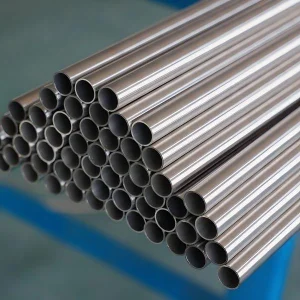
High-Quality Austenitic steel ASME SA213 · TP304H Manufacturer, Products

High-Quality Austenitic steel ASME SA213 · TP309S Suppliers, Product

High-Quality Duplex Steels 2205 • S31803/S32205 • 1.4462 Manufacturer, Products

Custom Austenitic steel ASME SA213 · TP316L Supplier, Factories

