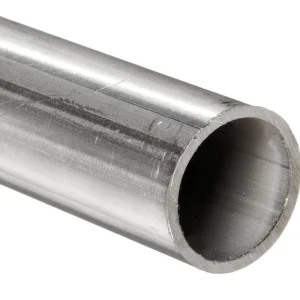
Featured High-Performance Corrosion Tubes (Part I)
Explore our certified range of seamless, welded, and precision-drawn alloy piping systems engineered for severe environments.








1. Metallurgical Science of CuNi 90/10 (UNS C70600 / DIN 2.0872)
A deep technical assessment of copper-nickel 90/10 piping systems: chemical stoichiometry, electrochemical corrosion mechanisms, and structural thermodynamics in marine engineering.
Stoichiometric Composition & Passive Film Thermodynamics
Copper-Nickel 90/10 (UNS C70600, EN 12449 CW352H, DIN 2.0872) represents an optimal single-phase alpha solid-solution alloy engineered specifically for extreme marine service. The addition of 10% nickel to copper significantly enhances its standard electrode potential while maintaining superior thermal conductivity.
Crucially, controlled additions of Iron (Fe: 1.0–1.8%) and Manganese (Mn: 0.5–1.0%) act as structural lattice stabilizers. Iron, when fully dissolved into the single-phase matrix during bright annealing, precipitates into the protective protective oxide film. This mechanism transforms the surface into a tenacious, self-healing Cuprous Oxide ($Cu_2O$) layer enriched with nickel sub-oxides ($NiO$), providing remarkable resistance to localized pitting and crevice attack in oxygenated seawater.
Biofouling Resistance & Shear Stress Limits
Unlike stainless steels and titanium alloys which suffer from severe macro-biofouling in static seawater, CuNi 90/10 inherently leaches copper ions ($Cu^{2+}$) at a microscopic, non-polluting rate (approx. 10 $\mu$g/cm²/day). This natural bio-static effect prevents the settlement of macro-organisms such as barnacles, mussels, and tubeworms, preserving line flow efficiency without requiring chemical biocide dosing.
From a fluid dynamics perspective, CuNi 90/10 exhibits a critical shear stress threshold of 4.5 to 5.5 m/s in seawater flow. Below its design velocity limit (typically 3.5 m/s for continuous service), the protective oxide layer remains stable, preventing erosion-corrosion damage across high-turbulence zones like elbows, tees, and heat exchanger tube inlets.
| Standard Specification | UNS Designation | Cu (%) | Ni (%) | Fe (%) | Mn (%) | Tensile Strength (MPa) | Yield Strength (MPa) |
|---|---|---|---|---|---|---|---|
| ASTM B111 / ASME SB111 | UNS C70600 | Remainder (88.5 min) | 9.0 – 11.0 | 1.0 – 1.8 | 1.0 max | ≥ 275 | ≥ 105 |
| EEMUA 144 / 234 | UNS C7060x | Remainder | 9.0 – 11.0 | 1.5 – 1.8 | 0.5 – 1.0 | ≥ 290 | ≥ 110 |
| DIN 86019 / BS 2871 | 2.0872 (CW352H) | Remainder | 9.0 – 11.0 | 1.5 – 1.8 | 0.5 – 1.0 | 290 – 360 | ≥ 120 |
2. Global Market Dynamics & Enterprise Procurement Drivers
Analyzing macroeconomic demand vectors, regulatory mandates, and structural material shifting in offshore energy, naval fleets, and municipal desalination.
Offshore Energy & Floating LNG (FLNG) Expansion
The global push toward transitional clean fuels has triggered unprecedented investments in Floating Liquefied Natural Gas (FLNG) platforms and FPSO topsides. These floating giants rely heavily on CuNi 90/10 for firewater mains, seawater cooling loops, and ballast systems due to its lightweight structural wall allowance under EEMUA 144 specifications combined with resistance to stress corrosion cracking (SCC) in marine splash zones.
Modernization of Global Naval & Defense Shipbuilding
Naval procurement authorities across North America, Europe, and Asia-Pacific are transitioning legacy surface combatants and submarines to standardized DIN 86019 CuNi 90/10 piping. By eliminating bio-fouling blockage risks and reducing acoustic vibration dampening characteristics compared to rigid duplex steels, CuNi 90/10 ensures operational readiness and stealth compliance for critical marine systems.
Large-Scale Thermal & RO Desalination Facilities
Arid coastal regions in the Middle East and North Africa (MENA) are expanding Multi-Stage Flash (MSF) and Reverse Osmosis (RO) infrastructure. Custom CuNi 90/10 heat exchanger tubes remain the benchmark specification for brine heater bundles and heat rejection sections, offering optimal thermal transfer efficiency coupled with immunity to ammonia-induced stress corrosion cracking.
3. China Industry 4.0: Precision Custom CuNi 90/10 Factory Excellence
How advanced smart manufacturing, digital quality control systems, and integrated supply chains deliver unmatched quality, rapid lead times, and structural cost advantages.
Smart Mill Integration & Process Control
Our state-of-the-art China production facility combines fully continuous cold-extrusion and triple-line pilgering processes with real-time digital monitoring. By leveraging automated laser micrometers and inline ultrasonic thickness sensors, we maintain wall thickness tolerances within $\pm 3.5\%$, far tighter than standard ASTM B111 parameters.
Every custom CuNi 90/10 pipe undergoes fully automated computer-controlled bright annealing in a pure hydrogen atmosphere. This eliminates surface oxidation, preserves microstructural phase balance, and ensures the iron content remains completely dissolved in solid solution, guaranteeing maximum corrosion resistance upon deployment.
Supply Chain Resilience & Cost Optimization
By establishing strategic upstream integration with refined copper cathode and high-purity nickel suppliers, our factory insulates international clients from global raw material volatility. Integrated raw-material-to-finished-tube processing reduces manufacturing throughput time by over 35% compared to European legacy mills.
- Full Heat Traceability: Direct digital binding from master heat ingot to individual finished pipe via laser-etched QR identifiers.
- Custom Dimensional Flexibility: Outer diameters ranging from 6 mm up to 419 mm, with custom wall schedules (EEMUA 144 / DIN 86019).
- Zero-Defect Quality Assurance: 100% Eddy Current Testing (ECT) and Hydrostatic testing up to 250 Bar prior to release.
4. Specialized Localized Engineering Applications
Engineered deployment matrices across critical global marine, petrochemical, power generation, and heavy industrial facilities.
Seawater Cooling & Fire Mains
Deployed in offshore oil rigs, commercial cargo vessels, and coastal power stations. CuNi 90/10 pipes transport high-salinity raw seawater for engine cooling, HVAC chillers, and emergency fire suppression networks without risk of bio-fouling clogging or rapid pitting corrosion.
Shell-and-Tube Heat Exchangers
Precision-drawn CuNi 90/10 U-bend and straight tubes are widely specified in power plant surface condensers and feed-water heaters. High thermal conductivity ($50 \text{ W/m}\cdot\text{K}$) ensures optimal thermal exchange while resisting erosion from turbulent steam flow.
Subsea Hydraulic & Piping Systems
Utilized in deep-water umbilical lines and subsea control manifolds. The high fatigue endurance strength of cold-worked CuNi 90/10 withstands intense ocean current vibrations and cyclical subsea pressure loads without micro-cracking.
5. E-E-A-T Quality Assurance & Certification Standards
Rigorous multi-stage verification procedures adhering to international marine classification societies (DNV, ABS, LR, BV, RINA).
Non-Destructive Testing (NDT) Protocol
Every single line of custom CuNi 90/10 piping manufactured in our factory undergoes rigorous NDT inspection before dispatch:
- Eddy Current Testing (ASTM E243): Detects micro-cracks, pinholes, and longitudinal flaws along the full 360° perimeter of the pipe.
- Hydrostatic Testing (ASTM B111): Hydro-pressurized up to 250 Bar (or internal pressure per ASME B31.3 formula) to guarantee hydrostatic structural integrity.
- Pneumatic Underwater Testing: Air pressure testing under clean water for heat exchanger tube bundles to verify zero-leak performance.
Destructive Metallurgical Auditing
To confirm compliance with global pressure vessel codes, random batch samples are subjected to laboratory destructive testing:
- Flattening & Flaring Tests: Expands tube ends up to 30% over nominal OD without evidence of grain separation or micro-fissures.
- Intergranular Corrosion Testing (ISO 3651): Verifies that heat treatment has fully eliminated grain boundary precipitation.
- EN 10204 3.1 & 3.2 Certification: Accompanied by full chemical spectro-analysis, mechanical property validation, and optional third-party inspector sign-offs (SGS, TUV, DNV).
6. Deep-Dive Technical FAQ & Procurement Guide
Expert engineering answers addressing material specification selection, fabrication guidelines, and logistics management.
What are the fundamental differences between CuNi 90/10 (C70600) and CuNi 70/30 (C71500)?
While both are copper-nickel alloys designed for marine service, CuNi 90/10 contains 10% nickel and higher iron content (1.0-1.8%), offering superior thermal conductivity, easier bendability, and higher natural resistance to bio-fouling at a lower cost. CuNi 70/30 contains 30% nickel, providing higher tensile strength and greater resistance to high-velocity water erosion (up to 4.5 m/s) and severe impingement attack, making it suitable for high-pressure marine systems and military submarines.
Can custom CuNi 90/10 pipes be welded easily on-site during ship installation?
Yes, CuNi 90/10 exhibits excellent weldability using standard arc welding processes including TIG (GTAW) and MIG (GMAW). It is essential to use matching filler metals (such as ERCuNi or AWS A5.7 C7060 filler). Cleanliness is paramount; all oil, grease, paint, and surface oxide must be removed prior to welding. Pre-heating is generally not required for standard wall thicknesses, but heat input must be controlled to prevent micro-fissuring.
Why is iron content so critical in CuNi 90/10 manufacturing specifications?
Iron (Fe) is a critical alloying element that directly governs erosion-corrosion resistance in flowing seawater. Without sufficient iron (below 1.0%), the protective protective cuprous oxide film ($Cu_2O$) is fragile and easily stripped away by fluid turbulence. However, if iron exceeds 1.8%, it can precipitate out of solid solution during cooling, leading to localized galvanic corrosion cell formation. Our Smart Mill annealing process ensures 100% of the iron remains homogeneously dissolved.
What dimensional standards and pressure schedules does your factory produce?
Our factory manufactures seamless and welded CuNi 90/10 pipes according to all major global specifications, including ASTM B111 / B466 (Standard US sizes), EEMUA 144 / 234 (Offshore 16 Bar & 20 Bar pressure ratings), and DIN 86019 / BS 2871 (Metric naval piping standards). Custom outer diameters, wall thicknesses, and radius U-bends are produced to exact client engineering drawings.
How does China Factory 4.0 ensure short lead times for international projects?
By utilizing continuous multi-strand cold drawing lines, automated annealing furnaces, and inline digital quality control, our mill reduces standard production cycles by over 30%. Furthermore, our proximity to major global port hubs in Shanghai and Ningbo allows for direct container loading, expedited customs clearance, and seamless ocean transport to global shipyards and construction sites.
What precautions should be taken during commission and seawater flushing?
During initial commissioning, piping systems should be flushed with clean, oxygenated seawater and operated at moderate flow velocities (1.5 to 2.0 m/s) for at least 30 days to allow the protective $Cu_2O$ film to fully mature. Contact with stagnant, sulfide-polluted water must be strictly avoided during initial commissioning, as sulfides disrupt protective oxide layer formation and cause rapid localized pitting.
Featured High-Performance Corrosion Tubes (Part II)
Complete product catalog featuring high-grade austenitic, super austenitic, nickel alloys, and titanium tubing solution series.