
Featured High-Pressure Tubing & Alloy Solutions
Explore our certified range of seamless, welded, and cold-drawn heat exchanger tubes engineered for severe thermal and chemical environments.






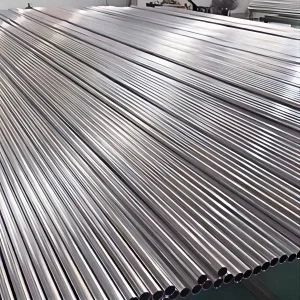

Engineering Principles of High-Pressure Nickel Alloy Heat Exchanger Tubing
In high-pressure shell-and-tube thermal systems, tube bundle integrity forms the ultimate safeguard against catastrophic process leakage, volatile fluid release, and expensive unscheduled shutdowns.
High Pressure Mechanical Integrity
Standard austenitic stainless steels often reach structural and thermodynamic limits when subjected to internal hydrodynamic pressures exceeding 1,000 bar (14,500 PSI) in combination with thermal cycling. Custom high-pressure nickel alloy tubes (including UNS N06625, UNS N10276, and UNS N08825) utilize face-centered cubic (FCC) solid-solution matrices reinforced by molybdenum, chromium, and niobium content. This metallurgy yields elevated yield strength, exceptional creep rupture endurance, and immune structural stability up to 650°C (1,200°F).
Pitting & SCC Immunity
Pitting Resistance Equivalent Numbers (PREN) for advanced high-pressure nickel alloys consistently surpass 45–68, compared to standard 316L (PREN ~24). Nickel concentrations exceeding 30% by weight eliminate Chloride-Induced Stress Corrosion Cracking (CSCC), while high Molybdenum (up to 16% in Hastelloy C-276) provides complete passivation against localized crevice corrosion in acidic brine, sour oilfield fluids ($H_2S$), and oxidizing mineral acids.
Precision Tight-Tolerance Cold Drawing
Custom manufacturing processes employ cold-pilgering and precision bench drawing routines to achieve outside diameter (OD) tolerances within ±0.05 mm and wall thickness (WT) uniformity within ±5%. This dimensional consistency minimizes thermal expansion stress differentials across the tubesheet, ensures ultra-tight tube-to-tubesheet orbital welding joints, and prevents flow-induced acoustic vibration failures.
Global Industry Trends in High Pressure Nickel Tubing
The global market for high-pressure nickel alloy heat exchanger tubes is undergoing structural transformations driven by energy transition mandates, deepwater oilfield exploration, and severe chemical process intensification.
1. Clean Energy & Supercritical CO2 Cycles
Next-generation concentrated solar power (CSP), modular nuclear reactors (SMRs), and supercritical $CO_2$ ($sCO_2$) power generation cycles operate at working pressures exceeding 250 bar and temperatures above 600°C. Standard alloys fail rapidly under these conditions due to severe oxidation and thermal creep. Demand is shifting rapidly toward custom cold-drawn Inconel 625 and Incoloy 800H heat exchanger tubes optimized for compact micro-channel heat exchangers (PCHE).
2. Ultra-Deepwater & Sour Gas (HPHT) Expansion
Offshore FPSO (Floating Production Storage and Offloading) topside gas compression and subsea reinjection systems are encountering higher concentrations of hydrogen sulfide ($H_2S$), carbon dioxide ($CO_2$), and elemental sulfur. High-Pressure High-Temperature (HPHT) wells mandate NACE MR0175 / ISO 15156 compliant nickel alloy 825 and C-276 heat exchanger tubes to withstand severe sour gas cracking and high differential pressures.
3. Transition to Zero-Downtime Life Cycles
Global plant operators are shifting CAPEX evaluation models to total Cost of Ownership (TCO). Replacing conventional stainless steel or duplex tubes every 3–5 years creates millions in lost production. High-performance nickel alloy heat exchanger tubing delivers service lifespans exceeding 25+ years without wall thinning or pitting, delivering significant long-term economic gains despite higher initial raw material costs.
Industry Insight: Hydrogen Economy Integration
The rapid scaling of green hydrogen production through high-pressure water electrolysis and steam methane reforming with carbon capture (CCUS) relies heavily on nickel alloy heat exchanger tubing (Alloy 600, 625, and 825). These alloys eliminate hydrogen embrittlement risks at operating pressures up to 700 bar.
Global Procurement Demands & Engineering Challenges
Procurement directors and chief engineers face complex metallurgical, supply chain, and regulatory hurdles when sourcing custom nickel alloy exchanger tubes for mission-critical projects.
Wall Concentricity & Ovality Control
When high-pressure exchanger tubes are expanded into thick tubesheets via mechanical rolling or hydraulic expansion, non-uniform wall thickness leads to localized micro-gaps, uneven mechanical stress, and joint leakage under thermal shock. Enterprise buyers demand strict concentricity (≥95%) and strict ovality control to ensure uniform contact stress.
Traceability & Raw Material Authenticity
Counterfeit master heats and inadequate solution annealing represent major risks in international sourcing. Leading EPC contractors require 100% Positive Material Identification (PMI), EN 10204 3.2 independent third-party certification (TÜV, DNV, SGS, Lloyd's), and origin verification back to certified premium master melt mills.
U-Bend Zone Integrity & Stress Relief
High-pressure shell-and-tube exchangers frequently utilize U-tube geometries. Cold bending introduces severe work hardening, wall thinning at the outer radius (extrados), and high residual tensile stresses. Global buyers require custom factory solution annealing for the bend region plus adjacent straight legs to restore corrosion resistance.
| Procurement Requirement | Standard Specification | Custom Factory High-Pressure Benchmark | Value Delivered |
|---|---|---|---|
| Hydrostatic Pressure Rating | ASTM B163 / ASME SB163 standard calculation | 100% Hydro-tested up to 1,500 bar with 10s hold | Zero failure guarantee during plant commissioning |
| NDT Flaw Detection | Standard Eddy Current (ASTM E426) | Dual-system ECT + Ultrasonic (UT) full length | Detects longitudinal, transverse, and sub-surface flaws |
| Surface Roughness (ID/OD) | Ra ≤ 0.8 μm (As-annealed) | Ra ≤ 0.4 μm Bright Annealed / Precision Polished | Prevents scaling, bio-fouling, and fluid pressure drop |
| Solution Annealing Quality | Batch heat treatment | Continuous atmosphere bright annealing (1,050°C–1,200°C) | Eliminates intergranular carbide precipitation |
Macro Industry Solutions for Extreme Environments
Tailored metallurgical combinations and custom manufacturing routes designed specifically for high-stress operational sectors.
Petrochemical & Sulfuric Acid Processing
Primary Alloys: Hastelloy C-276 (UNS N10276), Incoloy 825 (UNS N08825)
Operational Challenge: Extreme corrosion in reboilers, coolers, and condensers handling concentrated sulfuric acid, hydrochloric acid, and acetic acid at high temperatures.
Custom Solution: Cold-worked, bright-annealed seamless tubes with controlled low Carbon and Silicon content to prevent weld-seam corrosion and localized intermetallic phase formation.
LNG Liquefaction & Cryogenic Heat Exchangers
Primary Alloys: Inconel 625 (UNS N06625), Nickel Alloy 600 (UNS N06600)
Operational Challenge: High differential pressures combined with cryogenic temperatures (-196°C) cause severe embrittlement in standard ferritic materials.
Custom Solution: Austenite phase stabilized nickel matrix maintaining high impact toughness (>150 J at -196°C), preventing catastrophic brittle fracture in main cryogenic heat exchangers (MCHE).
Marine Desalination & Offshore FPSO Cooling
Primary Alloys: Monel 400 (UNS N04400), Super Duplex / Nickel 825
Operational Challenge: Severe marine biofouling, high-velocity seawater erosion, and crevice corrosion under tubesheet gaskets.
Custom Solution: Copper-Nickel and Nickel-Iron-Chromium custom tubes engineered for erosion velocities >4.5 m/s, forming passive oxide protective coatings under continuous turbulent seawater exposure.
High-Pressure Nickel Alloy Grade Specification Matrix
Compare mechanical characteristics, chemical designations, and international standards across our primary high-pressure exchanger tube alloys.
| Alloy Grade | UNS / W.Nr. | Nominal Composition | Yield Strength (MPa) | Max Temp (°C) | Primary Standards |
|---|---|---|---|---|---|
| Inconel 625 | UNS N06625 / 2.4856 | Ni 58% min, Cr 21.5%, Mo 9.0%, Nb 3.6% | ≥ 415 | 980°C | ASTM B444 / ASME SB444, ASTM B163 |
| Hastelloy C-276 | UNS N10276 / 2.4819 | Ni 57%, Cr 16%, Mo 16%, W 3.7% | ≥ 355 | 1040°C | ASTM B622 / ASME SB622, ASTM B163 |
| Incoloy 825 | UNS N08825 / 2.4858 | Ni 42%, Cr 21.5%, Fe 30%, Mo 3.0%, Cu 2% | ≥ 241 | 540°C | ASTM B163 / ASME SB163, ASTM B423 |
| Incoloy 800H | UNS N08810 / 1.4958 | Ni 32%, Cr 21%, Fe 45%, Al+Ti 0.8% | ≥ 205 | 815°C | ASTM B163 / ASME SB163, ASTM B407 |
| Monel 400 | UNS N04400 / 2.4360 | Ni 63% min, Cu 31%, Fe 2.5% | ≥ 195 | 480°C | ASTM B163 / ASME SB163, ASTM B165 |
* Note: Hydrostatic burst pressure calculations must be conducted in accordance with ASME Section VIII, Division 1, UG-27 equations taking into account tube wall tolerance, temperature derating factors, and joint efficiency factors.
Localization Support, QA/QC & Regulatory Compliance
Seamless global logistics, localized engineering compliance, and zero-compromise testing protocols ensure full compatibility with multinational project specifications.
Comprehensive Quality Control (QA/QC)
- 100% Non-Destructive Testing: Combined Eddy Current Testing (ECT) per ASTM E426 and Hydrostatic Testing up to 1,500 bar.
- Dimensional Verification: Laser micrometer OD measuring, ultrasonic wall thickness scanning, and straightness verification (≤ 1.0 mm/m).
- Destructive Testing Suite: Flare testing, flattening testing, reverse bend testing, intergranular corrosion testing per ASTM G28 / A262 Practice E, and tensile testing at ambient & elevated temperatures.
Localized Engineering & Regional Standards
- North America: ASME Boiler and Pressure Vessel Code (BPVC) Section II/VIII, ASTM B163/B444/B622, NACE MR0175/ISO 15156 compliance.
- European Union: Pressure Equipment Directive (PED) 2014/68/EU certification, AD 2000-Merkblatt W2/W10, EN 10216-5 testing protocols.
- Asia-Pacific & Middle East: KGS (Korea), METI (Japan), Aramco Materials System Specifications (SAMSS), and SABIC engineering standards.
Technology Roadmap & Future Innovations
Pioneering manufacturing methodologies to meet tomorrow's higher-pressure, higher-temperature, and micro-scale thermal requirements.
1. Internally Enhanced Fin & Micro-Groove Tubing
To maximize overall heat transfer coefficients ($\text{W}/m^2\cdot K$) while preserving outer burst strength, our factory is advancing internal helical micro-grooving for high-pressure nickel alloy tubes. This technology increases internal surface area by up to 40% and promotes turbulent boundary layer mixing, reducing total heat exchanger footprint by up to 25%.
2. Ultra-Fine Grain Microstructure Engineering
Through thermo-mechanical controlled processing (TMCP) during final cold drawing and bright annealing stages, fine grain sizes (ASTM Grade 8 or finer) are achieved. Fine grain structures dramatically enhance fatigue life under cyclic pressure pulsation and thermal shock while maintaining high stress-rupture ductility.
3. Smart Monitoring & Sensor-Embedded Tubing
Integrating fiber-optic Bragg grating sensors within outer sheath layers of high-pressure nickel tubes enables real-time monitoring of pressure distribution, localized temperature spikes, and strain deformation across critical heat exchanger zones, supporting predictive maintenance in Industry 4.0 plant architectures.
Frequently Asked Questions (Industry FAQ)
In-depth technical answers addressing critical selection, engineering, and manufacturing questions for high-pressure nickel alloy heat exchanger tubes.
Explore Additional Specialized Exchanger Tubing
Complete your procurement specification with our full portfolio of high-performance alloy tubing manufactured to international standards.








Request Custom High-Pressure Nickel Tube Quotation & Datasheet Review
Our senior metallurgical team reviews your temperature, pressure, medium composition, and ASME design code requirements to recommend the most reliable, cost-efficient alloy and custom tube processing specification.
