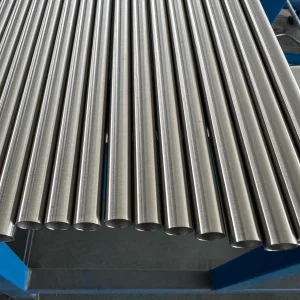
Featured Precision Alloy Tubing & Pipe Catalog
Explore our certified mill inventory and custom engineered corrosion-resistant tubular products manufactured in compliance with international ASTM, ASME, EN, and DIN specifications.








1. Comprehensive Technical Overview of Copper Nickel Alloy Pipes (CuNi)
Copper-Nickel alloys (commonly designated as Cupro-Nickel or CuNi) are solid-solution binary alloys constructed from copper and nickel, enhanced with controlled concentrations of iron (Fe) and manganese (Mn). Celebrated across marine engineering, nuclear power generation, and chemical process industries, these alloys deliver unmatched resistance to marine biofouling, impingement attack, pitting corrosion, and chloride stress-corrosion cracking (SCC).
CuNi 90/10 (UNS C70600 / DIN 2.0872)
The most widely specified copper-nickel grade for seawater piping systems. Composed of 90% Copper, 10% Nickel, with specific additions of 1.0–1.5% Iron and 0.5–1.0% Manganese. C70600 offers exceptional ductility, moderate high strength, superior thermal conductivity, and natural resistance to macro-fouling (barnacles, mussels, algae) without requiring toxic chemical dosing.
CuNi 70/30 (UNS C71500 / DIN 2.0882)
Formulated for severe, high-velocity marine environments and high-pressure thermal apparatus. Featuring 70% Copper and 30% Nickel with 0.4–1.0% Iron, C71500 provides higher tensile strength, enhanced resistance to erosion-corrosion, and superior stability under elevated operating temperatures up to 300°C (572°F) and extreme flow turbulences.
EEMUA 144 / 215 Naval Standards
Engineered to satisfy stringent offshore oil & gas and naval shipbuilding specifications. Pipes manufactured to EEMUA standards exhibit strict dimensional tolerances, optimized seam chemistry, seamless cold-drawn grain structure, and extended pressure ratings under cyclic marine wave loading.
Metallurgical Comparison: C70600 vs. C71500 Chemical & Mechanical Matrix
| Alloy Grade | UNS / EN Standard | Copper (Cu) | Nickel (Ni) | Iron (Fe) | Manganese (Mn) | Tensile Strength (MPa) | Yield Strength (MPa) |
|---|---|---|---|---|---|---|---|
| CuNi 90/10 | UNS C70600 / 2.0872 | Remainder (approx. 88.5%) | 9.0 – 11.0% | 1.0 – 1.8% | 1.0% Max | ≥ 290 MPa | ≥ 105 MPa |
| CuNi 70/30 | UNS C71500 / 2.0882 | Remainder (approx. 68.5%) | 29.0 – 33.0% | 0.4 – 1.0% | 1.0% Max | ≥ 380 MPa | ≥ 140 MPa |
| CuNi 94/6 | UNS C70400 / 2.0870 | Remainder (approx. 93.0%) | 5.0 – 7.0% | 1.3 – 1.7% | 0.3 – 0.8% | ≥ 275 MPa | ≥ 95 MPa |
The outstanding marine durability of copper-nickel pipes stems from the rapid development of a thin, protective surface film upon exposure to aerated seawater. This film consists predominantly of cuprous oxide (Cu₂O), which rapidly transforms over time into a complex cuprous hydroxychloride structure. This layer acts as a natural barrier against localized pitting and bio-organism attachment while releasing trace copper ions (Cu²⁺) that prevent bio-fouling settlement.
2. Strategic Advantages of Sourcing Copper Nickel Alloy Pipes from China Manufacturing Hubs
China has evolved into the world's premier industrial ecosystem for high-precision non-ferrous alloy tube and pipe manufacturing. Led by state-of-the-art production clusters in Zhejiang (Huzhou) and operations in Shanghai, Chinese factories provide unmatched value to global EPC contractors and industrial distributors.
Integrated Non-Ferrous Supply Chain
Chinese manufacturers maintain direct, vertically integrated partnerships with premium electrolytic copper refineries and high-purity nickel smelters. This integration ensures absolute control over raw material chemistry, drastically reduces metal melt impurities, and guarantees trace element stability (Fe, Mn content) crucial for passive oxide film creation.
Advanced Cold Pilgering & Annealing
Facilities utilize high-speed multi-roll cold pilger mills and automated bright annealing furnaces operating under hydrogen-nitrogen atmosphere. This guarantees dimensional precision with wall thickness tolerances controlled down to ±0.05 mm and internal surface roughness Ra < 0.4 µm for friction-free fluid transport.
100% Quality Testing & Traceability
Every single length of copper-nickel pipe undergoes 100% Non-Destructive Testing (NDT) — including Hydrostatic testing up to 250 Bar, Eddy Current inspection per ASTM E243, and Pneumatic underwater testing. Material Test Certificates (MTC) are issued strictly per EN 10204 3.1 or 3.2 with complete heat number mapping.
3. Global Industry Trends & Technological Innovations in CuNi Piping Systems
As global industrial investments transition toward decarbonization, ocean energy harvesting, and sustainable water infrastructure, copper-nickel alloy piping is experiencing technical innovations designed to meet higher operational pressures and aggressive environments.
- Expansion of Offshore Wind & Substation Cooling Loops: Off-shore high-voltage direct current (HVDC) converter platforms demand compact, highly reliable seawater cooling loops. CuNi 90/10 pipes are increasingly specified due to zero biofouling maintenance over 25+ years of unattended operation.
- Modular Desalination Plant Scaling: Mega-scale Reverse Osmosis (SWRO) and Multi-Stage Flash (MSF) desalination facilities in the Middle East and North Africa are substituting traditional synthetic piping with thick-walled C70600 and C71500 U-bend heat exchanger tubes to prevent bio-slime build-up and withstand brine erosion.
- Adoption of Automatic Orbital Welding: Modern shipyards and offshore module builders are abandoning manual brazing in favor of automated orbital TIG welding for CuNi piping systems. This requires tighter tube end squareness, precise wall uniformity, and low impurity control—standards natively supported by tier-1 manufacturers.
- Green Shipbuilding & Clean Marine Fuels: The global fleet's transition toward dual-fuel LNG and ammonia-powered propulsion systems requires cryogenic-compatible auxiliary sea-water cooling and firemain networks, driving sustained global demand for certified UNS C70600 seamless pipes.
4. Macro Industry Solutions & Application Scenarios
Copper-nickel alloy pipes serve as critical assets across diverse high-risk marine and chemical sectors where system downtime or fluid leakage is unacceptable.
Shipbuilding & Marine Engineering
Used extensively in seawater cooling systems, ballast piping, bilge lines, firemain loops, and sanitary seawater washdowns on naval frigates, commercial container vessels, and luxury yachts.
Desalination Facilities
Crucial for brine heaters, heat recovery evaporators, reject water discharge headers, and high-pressure sea water intake manifolds operating under high salinities.
Offshore Oil & Gas (FPSO)
Deploys CuNi 90/10 and 70/30 pipes for topside sea-water fire protection lines, hydraulic control tubing, seawater lift systems, and sheath protection on offshore platform legs.
Thermal & Nuclear Power Plants
Engineered into coastal power plant steam surface condensers, turbine auxiliary coolers, heat exchanger U-tube bundles, and generator cooling water circuits.
5. Global Enterprise Procurement Strategy & Quality Assurance Guide
When sourcing copper-nickel alloy pipes for critical industrial projects, procurement directors and engineering leads must implement rigorous technical validation protocols to mitigate supply chain risks.
1. Standards Compliance Verification
Ensure your supplier manufactures to exact international specifications: ASTM B111 / B466 (Standard Specification for Seamless Copper-Nickel Pipe and Tube), EEMUA 144/215 (Offshore Specification), DIN 85004, or MIL-T-16420K. Always request third-party witness inspection certificates (such as DNV, ABS, Lloyd's Register, or Bureau Veritas).
2. Flow Velocity Design Limits
Prevent premature erosion-corrosion failure by honoring critical design velocity thresholds during engineering reviews: Maximum recommended flow velocity for CuNi 90/10 (C70600) is 2.5 m/s (8.2 ft/s), whereas CuNi 70/30 (C71500) tolerates up to 3.5 m/s (11.5 ft/s) in continuous seawater service.
3. Packaging & Seaworthy Logistics
Copper nickel is a soft, high-value non-ferrous alloy susceptible to surface mechanical damage during transport. Demand heavy-duty seaworthy wooden box packaging, plastic end-capping on all pipe ends, moisture-proof plastic wrapping, and internal divider strips to prevent metal-to-metal rubbing.
6. Frequently Asked Questions (Technical & Commercial FAQ)
Detailed technical answers to common queries submitted by global project managers, naval architects, and industrial buyers.
Extended Stainless, Duplex & Titanium Tube Products
Discover our broader corrosion-resistant product lines manufactured across Huzhou production facilities to complement your complete piping project requirements.