
High-Performance Austenitic & Alloy Tubing Series
100% Eddy Current Inspected tubular products manufactured to ASME SA249, SA269, and EN standards for boiler, condenser, and process lines.






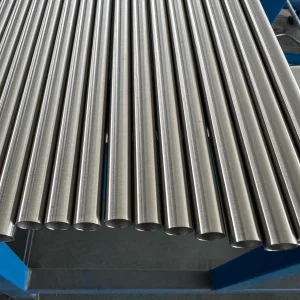

The Engineering Fundamentals of Inline Eddy Current Inspection (ECT)
Understanding electromagnetic induction testing protocols for critical welded stainless steel, super austenitic, duplex, and nickel alloy tubular products.
In high-pressure thermal exchange, chemical processing, and nuclear power generation systems, the structural integrity of welded stainless steel tubing is non-negotiable. Modern autogenous TIG and laser-welded tubing offers exceptional wall uniformity and geometric concentricity; however, micro-fissures, pinholes, incomplete weld penetration, or longitudinal lack-of-fusion defects can jeopardize entire industrial operations. Eddy Current Testing (ECT) stands as the primary non-destructive testing (NDT) technology used globally to guarantee zero-defect weld seams and longitudinal tube body soundness.
Electromagnetic Induction Principles in Austenitic & Alloy Alloys
Eddy Current Inspection operates based on Faraday's Law of Electromagnetic Induction. High-frequency alternating current is passed through an encircling test coil or probe configuration, generating a localized primary alternating magnetic field around the stainless steel tube. As the tube passes through the electromagnetic coil at high velocity, secondary circular electrical currents—known as eddy currents—are induced within the conductive metallic matrix of the tube wall.
When an internal or external discontinuity (such as a weld seam micro-crack, crater pipe, pinhole, or inclusions) interrupts the spatial flow of these induced eddy currents, the local electrical impedance of the coil changes dynamically. Advanced multi-frequency ECT instruments process these impedance variations, separating phase angle and amplitude signals to precisely detect, localize, and evaluate flaws in real time according to strict standards such as ASTM E426 and EN ISO 10893-1.
Encircling Coil Systems
Full 360-degree continuous electromagnetic coverage for high-speed inline detection of transverse and short longitudinal imperfections across the entire tube circumference.
Differential Coil Channel
Compares adjacent sections of the weld seam, eliminating background electrical noise, thermal drift, and subtle dimensional variations to isolate micro-defects with supreme SNR.
Phase Discrimination Tech
Separates signals caused by harmless surface roughness or permeability changes from true structural flaws, ensuring zero false negatives and optimal reject thresholds.
International ECT Standards & Defect Calibration Criteria
Rigorous calibration using Electro-Discharge Machined (EDM) reference standards guarantees accurate flaw detection for global engineering compliance.
| Standard Code | Scope & Application | Calibration Reference Flaw | Acceptance Criteria |
|---|---|---|---|
| ASTM E426 | Standard Practice for Electromagnetic (Eddy-Current) Examination of Seamless and Welded Tubular Products | Drilled holes (0.79 mm / 1.20 mm dia.) or EDM Longitudinal Notches (10% WT) | Zero signal output exceeding calibration alarm threshold |
| ASTM A249 / ASME SA249 | Welded Austenitic Steel Boiler, Superheater, Heat-Exchanger, and Condenser Tubes | Transverse drilled hole through tube wall per ASTM E426 | 100% NDT inline passing prior to hydrostatic or air-under-water pressure testing |
| EN ISO 10893-1 / EN 10246-2 | Non-destructive testing of steel tubes — Automated eddy current testing for verification of hydraulic leaktightness | Internal/External reference notches & drilled radial holes (Acceptance Level E1H/E2H) | Strict leak-tightness assurance with automated paint-spray defect marking and sorting |
| ASTM A269 / SA269 | Seamless and Welded Austenitic Stainless Steel Tubing for General Service | EDM longitudinal notches along weld seam and parent metal | Guaranteed structural integrity for hydraulic and instrumentation lines |
China Smart Manufacturing & Global Supply Chain Synergy
Combining raw material purity from Tier-1 steel mills with automated multi-pass tube manufacturing and integrated ECT quality gates.
Master Coil Material Purity
We source 100% AOD and VOD refined strip from world-class mills like Tsingshan, TISCO, and Baosteel. Low sulfur and phosphorus content ensures excellent weldability and minimal baseline electromagnetic noise during ECT scanning.
Inline Weld Bead Hammering & ECT
Our continuous production lines integrate internal/external weld bead rolling with online multi-frequency Eddy Current Inspection. Flaws are detected and painted automatically within milliseconds of welding.
Hydrogen Bright Annealing
Tubes undergo inline or offline heat treatment in 100% pure Hydrogen atmosphere furnace at 1050°C–1120°C. This eliminates internal residual stresses, restores micro-structural corrosion resistance, and ensures a mirror-smooth surface.
Cost Efficiency & Scale
By leveraging China's massive industrial ecosystem and automated mass-production capabilities, we deliver premium ECT-certified stainless steel tubing at highly competitive price points, backed by fast global freight logistics.
Global EPC Procurement & Total Cost of Ownership (TCO) Optimization
Why leading engineering firms specify 100% Eddy Current Inspected welded tubing to eliminate financial risks and unplanned plant shutdowns.
For international Procurement Directors and Engineering, Procurement, and Construction (EPC) contractors, selecting tubular products is a strategic decision that balances initial purchase cost against long-term risk exposure. While non-inspected commercial tubing may offer marginal upfront savings, a single pinhole leak in a power station condenser or chemical reactor can result in millions of dollars in lost operational uptime, environmental remediation, and catastrophic equipment damage.
By mandating 100% Eddy Current Inspection verified under ASTM A249 / ASME SA249, procurement managers achieve substantial TCO savings:
| Evaluation Parameter | Standard Commercial Welded Tube | Spezilla ECT-Certified Welded Tube | Seamless Stainless Tube |
|---|---|---|---|
| Weld Integrity Assurance | Visual / Basic Hydrostatic only | 100% Multi-frequency ECT + Hydrostatic | N/A (No weld seam) |
| Wall Thickness Tolerance | Moderate variance (±10-12.5%) | Ultra-uniform (±5-8% via cold drawing/rolling) | Higher eccentricity (±12.5-15%) |
| Relative Procurement Cost | Baseline (1.0x) | Cost-effective (1.1x - 1.25x) | High Premium (1.8x - 2.5x) |
| Heat Transfer Efficiency | Standard concentricity | Superior due to tight wall tolerances | Variable due to wall thickness variation |
| Risk of Unplanned Leakage | High risk over 5-year lifecycle | Zero defect guarantee at delivery | Low risk |
Industry Technological Evolution & Future ECT Innovations
Staying ahead of global clean energy shifts, ultra-clean semiconductor demands, and AI-driven quality inspection.
AI Signal Pattern Recognition
Integration of machine learning algorithms into digital ECT hardware. Neural networks analyze complex impedance plane signals, automatically classifying micro-defects versus harmless metallurgical noise with 99.9% accuracy.
Hydrogen & Clean Energy Shift
Rising global demand for high-pressure hydrogen transport lines and solar-thermal salt heat exchangers requires zero-defect austenitic TP316L, 321H, and Duplex 2205 tubing capable of enduring severe thermal cycling.
Ultra-Clean High-Purity Finish
Biopharmaceutical, semiconductor, and food processing lines demand electro-polished (EP) or bright-annealed (BA) internal bores (Ra < 0.25 µm) combined with 100% ECT to prevent bacterial colonization or particle contamination.
Localized Application Scenarios & Material Selection Guide
Engineered solutions matched to environmental corrosion profiles, design temperatures, and operating pressures.
1. Petrochemical & Refinery Condensers
Recommended Alloy: ASME SA249 TP316L / TP317L / Duplex 2205
Key Challenge: Exposure to hydrogen sulfide, sour gas, organic acids, and chloride-rich cooling water. ECT guarantees zero micro-fissures in weld seams, preventing catastrophic gas leaks into cooling towers.
2. Seawater Desalination Plants
Recommended Alloy: Super Austenitic 904L, UNS S31254 (6Mo), Titanium Grade 2
Key Challenge: Extreme pitting and crevice corrosion environment (PREN > 40). 100% ECT assures complete longitudinal seam fusion prior to seawater immersion service.
3. Power Plant Feedwater Heaters & Superheaters
Recommended Alloy: TP304H, TP316H, TP321H, TP310H
Key Challenge: Ultra-high thermal stress, cyclic creep exposure, and steam oxidation. High-carbon 'H' grades tested with ECT ensure defect-free high-temperature strength.
4. Food, Beverage & Sanitary Processing
Recommended Alloy: ASTM A270 TP304L / TP316L
Key Challenge: Strict CIP/SIP cleaning regimes. ECT combined with internal polishing prevents bacteria harbor points along the longitudinal weld seam.
Full Traceability & EN 10204 3.1 / 3.2 Mill Certification
Every meter of tubing is backed by transparent metallurgical testing, full heat number traceability, and independent third-party inspection capabilities.
Our commitment to quality assurance extends far beyond basic dimensional checks. Each shipment of Eddy Current Inspected Welded Stainless Steel Tubing is issued with a complete EN 10204 3.1 Mill Test Certificate (MTC) detailing:
- Chemical Composition Analysis: Spectrometric heat analysis verifying precise Cr, Ni, Mo, C, N, and trace element percentages.
- Mechanical Property Testing: Tensile strength, yield strength (0.2% offset), elongation, and Rockwell/Vickers hardness testing.
- Technological Mechanical Tests: Flattening test, flaring test, reverse bend test, and flange expansion tests per ASTM A1016 / A249.
- Metallurgical & Corrosion Tests: Grain size determination (ASTM E112) and Intergranular Corrosion (IGC) test per ASTM A262 Practice E.
- NDT Certification: 100% Eddy Current Inspection calibration strip charts, signal verification logs, and hydrostatic testing pressure records.
- Independent Inspection (EN 10204 3.2): Third-party witness inspection and stamping by TÜV, SGS, Lloyd's Register, DNV, or Bureau Veritas available upon request.
Titanium, Duplex & Super Austenitic Tubular Products
Explore our specialty corrosion-resistant alloy tubing portfolio certified for extreme industrial environments.







Frequently Asked Questions (Q&A) for Engineers & Procurement
In-depth technical answers regarding Eddy Current Inspection parameters, defect standards, and compliance.
Q1: What is the difference between differential coil and absolute coil ECT for welded tubing?
An differential encircling coil compares the electrical impedance of two adjacent sections of the tube simultaneously. It is exceptionally sensitive to localized abrupt discontinuities such as micro-cracks, pinholes, and weld seam lack-of-fusion, while effectively ignoring gradual changes like wall thickness drift or temperature variations. An absolute coil measures the absolute impedance at a single point, making it suitable for detecting long, gradual wall thinning or general conductivity variations. Most advanced ASTM A249 production lines utilize multi-channel systems combining both differential and absolute channels.
Q2: Can Eddy Current Testing (ECT) completely replace Hydrostatic Testing under ASTM A249 / ASME SA249?
Yes. Major international pressure equipment codes, including ASTM A249/A249M and ASME SA249, explicitly permit 100% automated non-destructive Eddy Current Testing per ASTM E426 as a standard alternative to hydrostatic pressure testing, unless hydrostatic testing is specifically specified by the end-user purchaser. In fact, inline ECT is superior at detecting microscopic pinholes and longitudinal seam cracks that might temporarily withstand static hydraulic pressure without leaking during a brief test window.
Q3: How are calibration standards prepared for verifying ECT equipment sensitivity?
Prior to every production run and at regular intervals during operation, the ECT equipment is calibrated using a reference tube sample of the exact same alloy grade, nominal diameter, and wall thickness. Per ASTM E426, reference standards feature artificially produced discontinuities: either radial drilled holes (typically 0.79 mm / 0.031 inch diameter) through the tube wall, or electro-discharge machined (EDM) longitudinal notches cut into the outer and inner surfaces to a depth of 10% of the nominal wall thickness. The signal response from these artificial defects defines the rejection threshold.
Q4: Why is Bright Annealing necessary before performing final Eddy Current Inspection?
Cold working processes (such as roll forming, tube sizing, and weld bead hammering) introduce localized cold-work stresses and magnetic permeability fluctuations in austenitic stainless steel tubing. If tested prior to solution annealing, these residual magnetic variations generate baseline electromagnetic noise that distorts the ECT signal-to-noise ratio (SNR). Hydrogen bright annealing at high temperature (1050°C+) fully recrystallizes the microstructure into a uniform, non-magnetic austenitic state, allowing the ECT equipment to detect true metallurgical flaws with maximum clarity.
Q5: How does Spezilla guarantee full traceability for international orders?
Every tube manufactured in our facilities receives a permanent inkjet or laser marking indicating manufacturer name, alloy grade, ASTM/ASME standard, outside diameter, wall thickness, heat number, and unique lot identification code. This heat number links directly back to the original steel mill ladle chemistry, coil slitting certificate, heat treatment chart, and ECT NDT chart recorded in our quality control database.
Q6: What is the standard lead time for custom ECT welded stainless steel tubing shipments?
For standard grades (such as TP304L and TP316L) in standard ODs (12.7 mm to 50.8 mm), raw master coils are maintained in stock, enabling production and dispatch within 15 to 20 days. For custom high-temperature or duplex grades (TP321H, TP310H, Duplex 2205) or customized U-bent bundle configurations, typical lead times range from 25 to 35 days, including full 100% ECT testing, hydrostatic verification, and EN 10204 3.1 certification packaging.
Request a Certified ECT Tubing Quotation
Need technical assistance selecting the ideal stainless steel, duplex, or titanium grade for your heat exchanger or process line? Our metallurgical engineers are ready to review your project specifications.
Contact Engineering Team