
Featured Austenitic & Special Alloy Tubing (Part I)
Precision-engineered welded and seamless tubing manufactured to rigorous ASTM, ASME, and EN specifications.






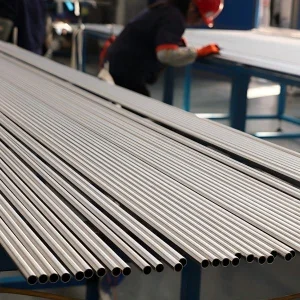

EN 10217-7 Technical Architecture & Metallurgical Principles
Understanding the European standard for welded stainless steel tubes for pressure purposes.
Scope & Material Classification
EN 10217-7 specifically governs circular welded stainless steel tubes intended for pressure and corrosion-resistant service at ambient, low, or elevated temperatures. It categorizes steel grades into key sub-families: standard Austenitic (e.g., 1.4301/304, 1.4404/316L), High-Temperature Stabilized Austenitic (1.4541/321, 1.4550/347), Super-Austenitic (1.4539/904L, 1.4547/254SMo), and Duplex/Super-Duplex steels (1.4462/2205, 1.4410/2507).
Test Categories: TC1 vs. TC2
EN 10217-7 designates two primary testing tiers: Test Category 1 (TC1) for standard industrial pressure requirements, and Test Category 2 (TC2) for critical applications requiring non-destructive testing (NDT) for longitudinal defect detection, mandatory intergranular corrosion testing (EN ISO 3651-2), and verified impact energy properties at sub-zero temperatures.
Laser Beam Welding (LBW) Advantage
Compared to conventional TIG (Tungsten Inert Gas) or Plasma Arc Welding (PAW), high-power Solid-State Fiber Laser Welding operates via a concentrated "keyhole" melting mechanism. This results in an ultra-narrow Heat-Affected Zone (HAZ), minimal grain growth, lower residual stress, and near-zero carbon pickup—preserving maximum pitting resistance equivalent numbers (PREN).
Information Gain Note: Why Laser Welding Supersedes Conventional TIG in EN 10217-7 Pipelines
Laser welding delivers a cooling rate order-of-magnitude faster than TIG welding. In stabilized austenitic grades (such as 1.4541/321 or 1.4550/347) and Duplex grades (1.4462), this extreme thermal gradient prevents unwanted phase precipitation—specifically chromium carbide precipitation at grain boundaries and sigma phase formation in Duplex microstructures—eliminating the risk of intergranular sensitization without requiring excessive post-weld solution annealing.
Global Procurement Landscape & Sectoral Intent Analysis
Mapping the macroeconomic demand vectors driving specifications for EN 10217-7 certified laser welded tubing.
| Industrial Sector | Target EN 10217-7 Grades | Critical Operating Conditions | Primary Sourcing Intent & Certification |
|---|---|---|---|
| Green Hydrogen & Fuel Cells | 1.4404 (316L), 1.4435, 1.4539 (904L) | High-pressure hydrogen embrittlement risk, ultra-pure gases | Inner surface roughness Ra < 0.4 μm, BA finish, EN 10204 3.1 MTC |
| Desalination & Marine Engineering | 1.4462 (Duplex 2205), 1.4410 (Super Duplex) | High chloride concentration, pitting, stress corrosion cracking (SCC) | PREN ≥ 35-42, mandatory ferric chloride pitting test (ASTM G48) |
| Chemical & Petrochemical Processing | 1.4438 (317L), 1.4550 (347), 1.4845 (310S) | Aggressive acids (H2SO4, HNO3), thermal cycling up to 1050°C | PED 2014/68/EU compliance, TC2 NDT testing, AD 2000-W2 certification |
| Pharmaceutical & Food Processing | 1.4301 (304), 1.4404 (316L) | Sanitary CIP/SIP cleaning, bio-burden containment | EN 10357 dimensional tolerances, mechanical polishing up to 400 mesh |
| Concentrated Solar & Nuclear Power | 1.4541 (321), 1.4878 (321H), UNS N08825 | Molten salt heat transfer, high creep-rupture stresses | Full grain-size control (ASTM E112), high-temperature yield verification |
EU CBAM & ESG Sourcing Pressures
With the European Union's Carbon Border Adjustment Mechanism (CBAM) coming into full force, procurement directors are favoring laser-welded pipes over seamless alternatives due to laser welding's substantially lower carbon footprint per linear meter. Laser welding consumes up to 65% less energy during manufacturing compared to heavy hot-extrusion seamless processes.
Total Cost of Ownership (TCO) Optimization
Laser welded tubes produced under EN 10217-7 TC2 offer wall thickness tolerances as tight as ±5% (compared to ±12.5% for seamless pipes under EN 10216-5). This precise concentricity reduces weight by up to 15% without sacrificing pressure rating, directly lowering freight, handling, and material expenditure.
Advanced Manufacturing & Precision Laser Metallurgy
From cold-rolled strip to bright-annealed pressure tube: the end-to-end quality route.
Phase 1: Continuous Roll-Forming
High-precision cold-rolled stainless steel strip (from Tier-1 mills like Outokumpu, Aperam, or Tsingshan) is uncoiled and fed into multi-stage precision rollers, forming a uniform cylindrical open profile with precise edge alignment.
Phase 2: Fiber Laser Welding & Shielding
Equipped with multi-kilowatt fiber lasers, the seam is fused autogenously (without filler wire). High-purity Argon/Helium gas trailing shields protect both top-bead and inner-root pass from atmospheric oxidation, ensuring zero tinting.
Phase 3: In-Line Bead Working & NDT
Internal and external weld beads are cold-rolled or scarfed to match the parent metal contour. In-line Eddy Current testing (EN 10246-2 / EN ISO 10893-2) screens 100% of the seam for micro-cracks or volumetric anomalies in real-time.
Phase 4: Bright Annealing (Solution Heat Treatment)
Tubes are passed through a continuous furnace in a pure hydrogen atmosphere at temperatures up to 1050°C–1120°C, followed by rapid quenching. This dissolves carbide precipitants, eliminates cold-working stress, and restores full austenitic ductility.
Industrial Applications & Macro-Engineering Solutions
Deployment frameworks for high-stress energy conversion and process infrastructure.
Shell and Tube Heat Exchangers
EN 10217-7 TC2 laser-welded tubes (specifically ASTM A249 / EN 10217-7 1.4404) are widely utilized in shell-and-tube exchangers. The smooth internal bore ensures minimal fouling factors, while uniform wall thickness delivers predictable heat transfer rates across large tube sheets.
Flue Gas Desulfurization (FGD) Systems
In power plants where sulfur dioxide (SO2) scrubbers create highly acidic, chloride-rich condensates, EN 10217-7 Super-Austenitic (1.4547 / 6Mo) laser welded pipes provide immunity to crevice corrosion at a fraction of the lead time of exotic nickel alloys.
LNG Liquefaction & Cryogenic Transport
Operating at temperatures down to -196°C, liquefied natural gas lines require exceptional Charpy V-notch impact toughness. EN 10217-7 low-carbon austenitic laser welded pipes maintain non-brittle crystalline structures under sub-zero cryogenic shock.
Compliance Assurance & Regional Localization Support
Navigating global regulatory frameworks, third-party inspections, and supply chain compliance.
Pressure Equipment Directive (PED 2014/68/EU)
For seamless integration into European pressure vessels, EN 10217-7 certified factories must hold valid PED certification issued by an EU Notified Body. Materials undergo mandatory verification of yield strength proof testing ($R_{p0.2}$) at elevated design temperatures.
EN 10204 3.1 & 3.2 Traceability
Every shipment is backed by EN 10204 3.1 Inspection Certificates containing full chemical ladle analysis, mechanical tension test results, flattening/flaring tests, and hydrostatic test pressures. Independent EN 10204 3.2 certification co-signed by TÜV, Lloyd's Register, or DNV is available upon request.
Regional Code Harmonization (EN vs. ASME)
Global EPC contractors often face conflicts between European EN standards and North American ASME codes. EN 10217-7 laser welded pipes can be dual-certified to ASME SA249 / SA312 and ASTM A249 / A312, satisfying both dual-stamp requirements and local municipal building codes.
Technology Roadmap & Future Outlook (2025–2035)
Emerging innovations transforming the laser-welded stainless tubing sector.
1. AI-Driven Real-Time Weld Monitoring
Integration of high-speed infrared thermography and optical pyrometry inside the laser welding head. Artificial intelligence algorithms analyze weld pool dynamics at 10,000 frames per second, automatically adjusting laser power and focal point to eliminate micro-porosity before seam solidifying occurs.
2. Hybrid Laser-Arc Welding (HLA W)
Combining high-density fiber lasers with Gas Metal Arc Welding (GMAW) allows single-pass welding of heavy wall EN 10217-7 pipes up to 12.7mm wall thickness. This hybrid approach yields deep penetration with structural gap-bridging capability, eliminating multi-pass beveling requirements.
3. Zero-Emission Green Steel Integration
Leading EN 10217-7 mills are transitioning to stainless steel coils smelted using Direct Reduced Iron (DRI) powered by 100% green hydrogen. Combined with solar-powered continuous bright annealing furnaces, lifecycle carbon intensity is reduced by up to 80% per ton produced.
Frequently Asked Technical & Procurement Questions (FAQ)
Expert engineering responses to critical questions encountered during specification and sourcing.
What is the primary technical difference between EN 10217-7 and EN 10216-5?
EN 10217-7 specifies welded stainless steel tubes for pressure purposes (produced via laser, TIG, or plasma welding), whereas EN 10216-5 governs seamless stainless steel tubes. Laser welded tubes under EN 10217-7 TC2 offer superior wall thickness uniformity, better internal concentricity, faster production lead times, and lower cost compared to EN 10216-5 seamless tubes, while achieving equivalent pressure ratings when a joint factor of $v=1.0$ is approved.
Why is laser welding preferred over traditional TIG welding for EN 10217-7 pipes?
Laser beam welding (LBW) delivers a concentrated energy density, enabling significantly higher welding speeds with minimal heat input. This results in an extremely narrow Heat-Affected Zone (HAZ), preventing grain coarsening and carbide precipitation. TIG welding involves a larger thermal pool, which can degrade corrosion resistance and cause thermal distortion unless extensive post-weld heat treatment is performed.
How does EN 10217-7 guarantee corrosion resistance along the weld seam?
Standard EN 10217-7 compliance requires full solution annealing (bright annealing) for critical grades, dissolving any micro-segregation formed during solidification. Furthermore, Test Category 2 (TC2) mandates intergranular corrosion testing per EN ISO 3651-2 (Method A or C), ensuring the weld seam matches the corrosion resistance of the parent metal.
What dimensional tolerances apply to EN 10217-7 laser welded pipes?
EN 10217-7 references EN ISO 1127 for dimensional tolerances. Standard outside diameter (OD) tolerances range from Class D3 (±0.75% or ±0.3mm) to Class D4 (±0.5% or ±0.1mm), while wall thickness (WT) tolerances achieve Class T3 (±10% or ±0.2mm) down to Class T4 (±7.5%), which is significantly tighter than equivalent seamless standards.
Can EN 10217-7 laser welded pipes be substituted for ASME SA312 / ASTM A312 welded pipes?
Yes, in most international engineering projects, EN 10217-7 tubes can be dual-certified to ASTM A312 / ASME SA312 provided the chemical composition, mechanical strength, wall tolerances, and non-destructive testing requirements of both standards are satisfied simultaneously. Dual certification must be clearly requested prior to order execution.
What non-destructive testing (NDT) standards are mandatory for EN 10217-7 TC2 certification?
For EN 10217-7 TC2 certified tubing, 100% of the pipe length must undergo non-destructive eddy current testing per EN ISO 10893-2 (for longitudinal defect detection) or hydrostatic testing per EN ISO 10893-1. Radiographic (X-ray) testing per EN ISO 10893-6 can also be specified for critical pressure containment welds.
Featured Austenitic & Special Alloy Tubing (Part II)
High-temperature, super duplex, and titanium tube products for demanding global projects.








