
1. Executive Overview & Metallurgy of Mechanical Polishing
In ultra-high purity (UHP) fluid handling, hygienic bioprocessing, structural architecture, and severe marine environments, the surface topography of stainless steel, titanium, and nickel alloy tubing dictates both operational longevity and thermodynamic efficiency. Surface finishing is not merely aesthetic—it is a critical mechanical process governing micro-roughness ($Ra, Rz, Rmax$), boundary layer shear stress, micro-structural stress relief, and passive chromium-oxide film integrity.
The Mechanics of Micro-Surface Finishing
Industrial mechanical finishing is divided into two primary disciplines: Satin (Directional Grain/Brushed) Finishing and Mirror (Specular Reflection 8K/10K) Finishing. Both processes alter the material surface at the sub-micron scale, removing micro-burrs, mechanical fissures, and oxide scale resulting from cold drawing or seam welding.
Through precise multi-stage abrasive grinding—utilizing silicon carbide ($SiC$), aluminum oxide ($Al_2O_3$), and diamond paste compounds—factories transition tubular products from raw mill finish ($Ra \ge 3.2\,\mu\text{m}$) down to ultra-smooth specular mirrors ($Ra \le 0.02\,\mu\text{m}$).
2. High-Precision Polished Alloy Tubes (Catalog Selection A)
Explore our primary inventory of austenitic steel, titanium, and heat-resistant alloy tubing engineered for chemical, pharmaceutical, and high-pressure service.


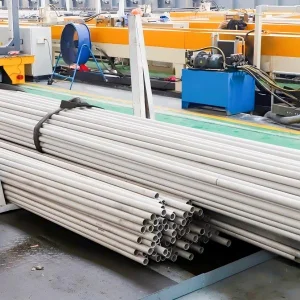





3. Comprehensive Engineering Matrix: Satin vs. Mirror Finishes
Understanding the micro-geometrical and mechanical performance variations between Satin (Hairline/Scotch-Brite) and Mirror (8K Specular/Electropolished) finishes is essential for specifying tubing across pharmaceutical, chemical processing, and marine architecture sectors.
| Performance Parameter | Satin / Brushed Finish (180 - 400 Grit) | Mirror Finish (600 - 2000 Grit Mechanical) | Electropolished Mirror Finish (EP 8K/10K) |
|---|---|---|---|
| Typical Ra Value ($\mu\text{m}$) | $0.40\,\mu\text{m} - 0.80\,\mu\text{m}\quad (16 - 32\,\mu\text{in})$ | $0.10\,\mu\text{m} - 0.25\,\mu\text{m}\quad (4 - 10\,\mu\text{in})$ | $≤ 0.05\,\mu\text{m} - 0.10\,\mu\text{m}\quad (≤ 2 - 4\,\mu\text{in})$ |
| Surface Profile Morphology | Unidirectional micro-grooves; controlled diffuse reflectivity. | Flattened micro-peaks; high specular light reflection. | Featureless, smooth micro-undulations; complete microscopic levelling. |
| Cleanability & CIP Compliance | Moderate. Suitable for non-sanitary process lines and exterior cladding. | High. Excellent washdown characteristics; resists bio-film attachment. | Ultra-High (ASME BPE Class SF4/SF5 compliant). Maximum CIP/SIP efficiency. |
| Corrosion Resistance (Pitting) | Standard base metal corrosion rate; grain boundaries exposed. | Improved pitting resistance due to reduced micro-crevice depth. | Superior. Increases Cr/Fe ratio (>1.5) and thickens passive oxide film. |
| Primary Application Sectors | Architectural trim, heat exchanger outer casings, structural frames. | Food & Dairy fluid transfer, cosmetic vessels, cleanrooms. | Biopharmaceutical bioreactors, high-purity semiconductor gases (UHP). |
Mechanical Satin Buffing
Utilizes abrasive belt grinding followed by non-woven synthetic flaps (Scotch-Brite) to establish uniform longitudinal grain structures. Eliminates handling scratches and thermal discoloration from welding operations.
8K Super Mirror Polishing
Progressive multi-stage mechanical buffing using liquid aluminum oxide slurries and wool felts. Removes macro-peaks down to a specular optical reflectivity exceeding 90% at a 60-degree light incidence.
Anodic Electropolishing
Electrochemical dissolution process in a temperature-controlled phosphoric/sulfuric acid bath. Preferentially strips metal ions from microscopic peaks, enriching chromium concentrations at the outer layer.
4. China's Integrated Factory Supply Chain Advantages
China's specialty steel and tubing manufacturing ecosystems—concentrated in industrial hubs like Zhejiang (Huzhou/Wenzhou) and Jiangsu (Wuxi/Jiangyin)—offer unmatched structural efficiency, raw material security, and technological capacity for high-volume polishing production.
Vertical Supply Chain Integration
Our production facilities maintain complete control over the value chain—from vacuum induction melting (VIM) and electroslag remelting (ESR) ingots down to cold drawing, bright annealing, and multi-axis mechanical polishing.
Economies of Scale & Cost Efficiency
By operating automated high-speed OD/ID polishing lines alongside centralized acid recovery and zero-discharge electropolishing infrastructure, Chinese factories deliver premium polished tubing at 25-40% lower capital outlay.
Advanced Automated CNC Polishing
Integration of multi-head robotic polishing cells ensures precise control over head pressure, feed rates, and lubricant application, yielding 100% surface uniformity along continuous tube lengths up to 25 meters.
5. Global Enterprise Procurement: Auditing & Quality Verification
For tier-1 EPC contractors and global original equipment manufacturers (OEMs), procuring polished tubing from overseas factories requires rigorous non-destructive testing (NDT), traceability verification, and surface metrology standards.
Surface Profilometry & Metrology
Every polished batch undergoes contact-stylus profilometry and non-contact white light interferometry testing. Roughness metrics ($Ra, Rz, Rk$) are recorded at 90-degree intervals across both ID and OD surfaces.
Auger Electron Spectroscopy (AES)
For electropolished biopharmaceutical tubing, AES micro-analysis verifies that the passive layer depth exceeds 15 Angstroms and confirms a Chromium-to-Iron ratio ($Cr/Fe \ge 1.5$), satisfying ASME BPE SF4 metrics.
NDT & Metallurgical Verification
100% Eddy Current Inspection (ECT), hydrostatic testing up to 300 bar, and pneumatic under-water leak checks ensure zero micro-fissures or weld seam defects prior to polishing operations.
6. Sector-Specific Application Scenarios & Engineering Case Studies
Surface requirements vary dramatically depending on the mechanical, chemical, and biological demands of the operational environment.
Biopharmaceuticals & Vaccines
Requirement: ASME BPE SF4 Electropolished ($Ra \le 0.38\,\mu\text{m}$).
Eliminates bacterial adherence, rouge accumulation, and contamination in Water-For-Injection (WFI) distribution loops and fermentation reactors.
Semiconductor UHP Gas Lines
Requirement: Ultra-High Purity EP 10K Mirror Finish ($Ra \le 0.1\,\mu\text{m}$).
Prevents gas outgassing and particle generation in sub-nanometer wafer fabrication process lines using reactive gases ($HCl, NH_3$).
Food, Dairy & Beverage Systems
Requirement: Mechanically Polished Mirror ($Ra \le 0.4\,\mu\text{m} - 0.8\,\mu\text{m}$).
3-A Sanitary and EHEDG compliant. Supports automated Clean-In-Place (CIP) cycles without chemical residual buildup.
7. Technological Trends: AI Metrology & Green Chemical Polishing
The industrial finishing landscape is experiencing a paradigm shift driven by artificial intelligence, real-time optical scanning, and sustainable closed-loop chemical engineering.
AI-Driven Optical Defect Recognition
High-resolution neural networks inspect polished ID/OD surfaces in real time during production. Machine vision systems identify micro-scratches, pits, or uneven grit density down to $0.5\,\mu\text{m}$ at line speeds up to 30 meters per minute.
Eco-Friendly Closed-Loop Acid Recovery
Modern factories incorporate advanced crystallization and electro-dialysis systems to recycle 98% of spent electropolishing electrolytes. Acid mist recovery scrubbers ensure zero-volatile organic compound (VOC) emissions.
Robotic Multi-Axis Polishing Cells
6-axis articulated robots equipped with force-torque feedback sensors maintain uniform pressure across complex U-bends, serpentines, and fittings, ensuring consistent wall thickness and surface quality throughout complex geometries.
8. High-Precision Polished Alloy Tubes (Catalog Selection B)
Review our specialized tubing selection including low-carbon austenitic grades, nickel-molybdenum alloys, and stabilized stainless steel for ultra-corrosive duty.








9. Global Compliance, Quality Standards & Certification Framework
Regulatory compliance is non-negotiable for industrial fluid systems. Our polished tube production adheres to strict international quality codes, backed by certified raw material heat numbers and full EN 10204 3.1/3.2 inspection reporting.
ASTM / ASME Mechanical Standards
Full compliance with ASTM A213 (seamless alloy heat-exchanger tubes), ASTM A249 (welded heat-exchanger tubes), ASTM A269 (general service tubing), and ASTM A270 (sanitary tubing specifications).
ASME BPE & EHEDG Hygienic Standards
Adherence to ASME BPE surface finish classifications (SF1 through SF6). Certified for European Hygienic Engineering & Design Group (EHEDG) guidelines and 3-A Sanitary Standards for food processing.
EN 10204 3.1 / 3.2 Traceability
Every shipment includes an EN 10204 3.1 Mill Test Certificate detailing chemical analysis, mechanical property testing, grain size verification, and dimensional surface inspection certified by independent auditors.
10. Frequently Asked Questions (Technical & Procurement Q&A)
Detailed answers to the top engineering, metallurgical, and supply chain queries encountered during international procurement.
Q1: What is the primary difference between mechanical 8K mirror polishing and electropolishing?
Mechanical 8K polishing relies on abrasive compound grinding to physically smear and flatten microscopic surface peaks, achieving visual mirror reflectivity ($Ra \approx 0.1\,\mu\text{m}$). Electropolishing is an electrochemical process that anodically dissolves surface metal, preferentially stripping peaks without cold-working the lattice. Electropolishing yields superior corrosion resistance by boosting the surface Chromium-to-Iron ratio ($Cr/Fe \ge 1.5$) and eliminating mechanical stress layers.
Q2: How does surface roughness ($Ra$) impact corrosion resistance in chloride environments?
A rougher surface ($Ra > 0.8\,\mu\text{m}$) contains microscopic valleys and crevices where chloride ions ($Cl^-$) accumulate, initiating localized pitting and crevice corrosion. Smoothing the surface to an $Ra \le 0.38\,\mu\text{m}$ decreases micro-stagnant zones, preventing chloride concentration cell formation and extending the critical pitting temperature (CPT) of austenitic stainless steels.
Q3: Can internal diameter (ID) polishing be conducted on small-diameter precision tubes?
Yes. Factories utilize abrasive flow machining (AFM) or multi-pass internal mechanical hone lines to polish tubes down to internal diameters as small as $4.0\,\mm$. For ultra-high purity applications, specialized flexible electrode internal electropolishing systems are deployed to achieve ID $Ra \le 0.15\,\mu\text{m}$.
Q4: What standards define sanitary tubing surface requirements for biopharmaceuticals?
ASME BPE (Bio-Processing Equipment) is the gold standard. It defines surface finish designations SF1 through SF6. For example, SF1 specifies a maximum mechanically polished $Ra$ of $0.51\,\mu\text{m}$ ($20\,\mu\text{in}$), while SF4 requires an electropolished finish with a maximum $Ra$ of $0.38\,\mu\text{m}$ ($15\,\mu\text{in}$).
Q5: Why choose Grade 317L or 316L over standard Grade 304 for polished industrial tubing?
316L and 317L contain Molybdenum ($2.0-3.0\%$ in 316L; $3.0-4.0\%$ in 317L), which significantly increases the Pitting Resistance Equivalent Number (PREN). Higher PREN values protect polished surfaces against aggressive pitting attack in halide solutions, organic acids, and pharmaceutical process media.
Q6: What quality documentation is provided with factory-polished tubing orders?
Orders ship with EN 10204 3.1 or 3.2 Mill Test Certificates detailing raw heat chemistry (ICP-OES), tensile/yield strength, hardness, eddy current test results, hydrostatic test pressure logs, profilometer surface roughness charts, and chemical passivation test reports (ASTM A380/A967).
