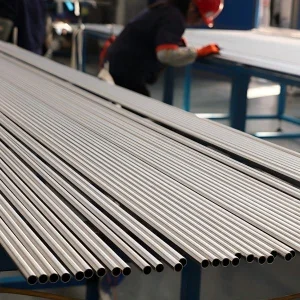
Featured Precision Alloys & Certified Tube Portfolio
Explore our specialized range of high-performance austenitic, duplex, super austenitic, and alloy tubing, manufactured to international ASTM, ASME, and EN specifications with 100% welded seam integrity verification.







1. Executive Technical Overview: The Metallurgy of Welded Seam Integrity
Understanding why seam integrity forms the foundational structural pillar of modern thermal equipment, chemical reactors, and extreme-environment fluid systems.
In high-pressure shell-and-tube heat exchangers, steam condensers, nuclear feedwater heaters, and chemical processing facilities, the structural integrity of tubular welded seams is non-negotiable. Historically, engineering design codes imposed penalizing joint efficiency factors (often reducing allowable stress by 15% to 35%) on welded tubing due to risks of micro-porosity, incomplete fusion, and localized heat-affected zone (HAZ) sensitization. Modern Custom Welded Seam Integrity Factories have revolutionized this paradigm by combining precision continuous automated welding, full cold-working bead reduction, advanced inline non-destructive testing (NDT), and computer-controlled bright annealing.
Achieving true welded seam integrity requires controlling metal fusion at the microscopic scale. During automated Gas Tungsten Arc Welding (GTAW/TIG), Laser Beam Welding (LBW), or High-Frequency Induction (HFI) welding, the molten weld pool undergoes rapid solidification dynamics. Without rigorous process controls, this solid-liquid phase transformation can lead to elemental segregation—specifically the depletion of key alloying elements such as Chromium (Cr), Molybdenum (Mo), and Nickel (Ni) along dendrite boundaries.
Core Technical Insight: Weld seam integrity is not merely the absence of geometric defects like cracks or undercut; it is the achievement of metallurgical homogeneity where the mechanical properties, corrosion resistance, and microstructural phase balance of the seam match or exceed that of the parent strip metal.
Microstructural Zones & Solidification Mechanics
A precision welded tube seam consists of three primary thermal zones:
- The Fusion Zone (FZ): The re-melted metal where solidification morphology (cellular vs. dendritic) determines tensile yield strength and toughness. Optimal arc geometry and inert backing gas (typically High-Purity Argon or Argon-Hydrogen mixtures) prevent atmospheric oxygen and nitrogen pickup.
- The Heat-Affected Zone (HAZ): The solid-state region adjacent to the fusion line subjected to extreme thermal cycles. In austenitic stainless steels (such as TP304H, TP316H, and TP321H), controlling thermal input prevents carbide precipitation along grain boundaries, avoiding intergranular corrosion (IGC).
- The Base Metal (BM): The cold-rolled, high-concentricity strip stock sourced from tier-one steelmakers, providing consistent chemical purity and tight thickness tolerances.
Autogenous Laser & Plasma Arc Welding
Utilizes ultra-high energy density to create narrow fusion zones with minimal thermal distortion, optimizing solidification rate and suppressing micro-segregation in high-alloy steels.
Internal Bead Cold Working (Bead Rolling/Sinking)
Mechanical cold working flushes the internal and external weld bead flush with the tube surface, eliminating stress concentration points and recrystallizing the cast structure during annealing.
Continuous Atmosphere Bright Annealing
Thermal processing at temperatures up to 1150°C under 100% pure Hydrogen atmosphere dissolves precipitated phases, relieves residual welding stresses, and restores full corrosion resistance.
2. The 360° Non-Destructive Testing (NDT) & Quality Assurance Blueprint
How specialized factories implement multi-stage continuous NDT to guarantee zero-defect seam integrity across millions of meters of critical tubing.
To qualify as a premier Custom Welded Seam Integrity Factory, a facility must transition from sample-based quality checking to continuous digital inspection ecosystems. Tubing deployed in high-pressure or lethal fluid services cannot tolerate microscopic wall discontinuities, pinholes, or lack of penetration.
| Inspection Technology | Governing Specification | Target Defect Type | Operational Methodology |
|---|---|---|---|
| Inline Eddy Current (ECT) | ASTM E426 / EN 10246-2 | Pits, pinholes, longitudinal seam cracks, arc strikes | Encircling coil & sector probe differential signal analysis operating continuously post-welding. |
| Ultrasonic Testing (UT / PAUT) | ASTM E213 / EN 10246-7 | Internal wall laminations, lack of side-wall fusion, wall thickness drift | High-frequency sound wave reflection (5-15 MHz) mapping internal cross-sectional sound paths. |
| Hydrostatic Pressure Testing | ASTM A1016 / ASME SA1016 | Yield boundary failure, structural seam weepage | Pressurization up to 300+ bar (4,350 PSI) sustained for 10-12 seconds under digital pressure transducer monitoring. |
| Pneumatic Air-Under-Water | ASTM A249 / Grade Standard | Micro-porosity leak paths (< 10⁻⁵ mbar·l/s) | Submerged air testing at 1.5 to 2.5 MPa while inspecting for micro-bubble release along the full seam length. |
| Digital Radiography (RT) | ASME Section V Article 2 | Internal voids, tungsten inclusions, root concavity | X-ray real-time imaging for thick-wall heat exchanger U-bends and critical alloy transition zones. |
Destructive Metallurgical & Mechanical Validation
Non-destructive examination is complemented by rigorous batch-level mechanical destructive testing per ASTM A249 / A213 standards:
- Reverse Flattening Test: A section of tube is split 180° opposite the weld and flattened. The weld seam is subjected to maximum bending stress at the outer fibers; zero cracking or wall separation is permitted.
- Flange & Expansion Testing: Tube ends are expanded over a tapered mandrel until the outside diameter increases by 15% to 30% without tearing along the fusion zone.
- Intergranular Corrosion (IGC) Testing: Execution of ASTM A262 Practice E (Copper-Copper Sulfate-16% Sulfuric Acid test) to verify that heat treatment completely eliminated chromium carbide precipitation at the grain boundaries.
3. Global Industrial Trends: Shift from Seamless to High-Integrity Welded & Drawn (W&D)
Analyzing economic factors, precision tolerances, and metallurgical developments driving global EPCs toward advanced welded tube solutions.
Superior Wall Uniformity & Concentricity
Seamless tubes often suffer from wall thickness eccentricity up to ±12.5% due to rotary piercing drift. Welded tubes formed from precision cold-rolled strip guarantee wall variation within ±5%, improving heat transfer rates and reducing thermal hot-spots.
Green Hydrogen & CCUS Integration
Emerging decarbonization infrastructure demands high-pressure hydrogen transport lines and Carbon Capture storage condensers capable of resisting hydrogen embrittlement and supercritical CO2 corrosion at optimized capital expenditure.
Cost Efficiency & Lead Time Reduction
Welded and Cold Drawn (W&D) manufacturing pathways deliver up to 25-40% procurement savings compared to nickel-alloy seamless tubing while meeting ASME SA249/SA688 strict pressure retention requirements.
Global Regulatory & Code Evolution
The global engineering landscape has increasingly unified around stringent compliance frameworks. Codes such as ASME Boiler and Pressure Vessel Code (BPVC) Section VIII Division 1 & 2, the European Pressure Equipment Directive (PED 2014/68/EU), and NORSOK M-630 (for offshore installations) now explicitly accept high-integrity welded tubing with joint factor E=1.0 provided 100% NDT inspection protocols are documented via EN 10204 3.1 or 3.2 inspection certificates.
4. China Industry 4.0: Supply Chain Resilience & Smart Factory Advantages
How China's advanced manufacturing infrastructure in Huzhou and Shanghai integrates automated laser vision, real-time telemetry, and vertical material sourcing to deliver unmatched reliability.
The global manufacturing ecosystem for specialized tubing has undergone a profound transformation. Modern Chinese industrial hubs, notably in Huzhou (Zhejiang) backed by corporate operations in Shanghai, represent the pinnacle of Industry 4.0 Custom Welded Seam Integrity Factories. By combining complete raw strip vertical integration with AI-assisted manufacturing telemetry, these facilities eliminate traditional supply chain bottlenecks while elevating quality metrics.
Closed-Loop Laser Seam Tracking
Real-time optical sensors dynamically adjust welding torch position, heat input, and shielding gas flow rate within millisecond response windows, eliminating edge misalignment and burn-through.
Digital MTC & Blockchain Traceability
Every tube length is laser-etched with unique matrix barcodes linking directly to chemical heat analysis, mechanical yield data, bright annealing temperature logs, and EN 10204 3.1/3.2 certificates.
Tier-1 Raw Material Integration
Direct supply contracts with top-tier mill refiners (TISCO, Baosteel, Outokumpu) ensure pristine strip chemistry with ultra-low S, P, and O levels, optimizing weld pool fluidity and corrosion performance.
5. Grade-Specific Metallurgical Engineering & Material Performance Benchmarks
Technical comparison of key alloy families processed in high-integrity welded seam manufacturing environments.
| Alloy Classification | Representative Grades | PREN Range | Key Weld Seam Metallurgical Focus | Primary Industrial Applications |
|---|---|---|---|---|
| Austenitic Steels | TP304H, TP316L, TP321H, TP347H, 310S | 19 – 25 | Carbide stabilization (Ti/Nb additions), preventing sensitization during high-temperature service (> 550°C). | Refinery heaters, superheaters, food processing lines, general process piping. |
| Super Austenitics | 904L, 254SMO (UNS S31254 / 1.4547) | 34 – 44 | High Mo (6%) segregation control during pool freezing; requiring fast cooling to prevent sigma phase precipitation. | Flue gas desulfurization (FGD), marine scrubbers, phosphoric acid production. |
| Duplex & Super Duplex | UNS S31803, S32205, S32760 (1.4501) | 35 – 43+ | Maintaining 40-60% Ferrite-Austenite phase balance across fusion line using nitrogen-boosted shielding gases. | Offshore oil & gas, subsea manifolds, seawater reverse osmosis (SWRO) desalination. |
| Nickel Alloys | Alloy 400, Alloy 600, Alloy 825, Alloy C276 | N/A (Ni-base) | Managing thermal hot-shortness, narrow solidification ranges, and ensuring zero micro-fissuring in molten pool. | Chemical reactors, hydrofluoric acid alkylation, sour gas (H2S) processing wells. |
| Titanium Alloys | Grade 1, Grade 2, Grade 12 (UNS R53400) | Immune to Cl- | Trailing inert gas chamber purging (O2 < 10 ppm) to prevent embrittling alpha case formation along the seam. | Power plant surface condensers, coastal heat exchangers, titanium chlorination systems. |
6. Localized Application Scenarios & Failure Prevention Case Analysis
Real-world operational engineering scenarios demonstrating how custom seam integrity prevents premature plant failure.
Scenario A: Coastal Desalination & Seawater Cooling
Environment: High chloride content (> 20,000 ppm Cl-), ambient to 80°C operating temperatures.
Failure Risk: Severe pitting corrosion along un passivated weld seam ridges.
Factory Solution: Welded Super Duplex S32760 / 254SMO tubes subjected to full bead cold rolling and bright annealing, achieving smooth surface roughness (Ra < 0.4 μm) and zero micro-segregation.
Scenario B: Petrochemical Steam Superheaters
Environment: Cyclic thermal stresses up to 650°C under internal pressure.
Failure Risk: Creep rupture occurring along grain-coarsened heat-affected zones.
Factory Solution: ASME SA213/SA249 TP316H / TP321H high-carbon stabilized austenitic tubes with controlled grain size (ASTM 7 or coarser) to optimize long-term creep rupture strength.
Scenario C: Ultra-Pure Sanitary Bio-Pharma Lines
Environment: Clean-In-Place (CIP) and Steam-In-Place (SIP) chemical washdown.
Failure Risk: Bacterial entrapment in micro-porosity or bead overlap.
Factory Solution: Mechanically polished and electropolished ASME BPE compliant tubing with internal seam flushness verified by borescope optical inspection.
7. Strategic Procurement Guide: Auditing a Custom Welded Seam Integrity Factory
A practical evaluation framework for global EPC procurement directors and quality assurance managers.
When selecting an OEM factory for critical alloy tubing, procurement managers should look beyond base unit pricing. A comprehensive Total Cost of Ownership (TCO) evaluation considers tube longevity, pressure safety margins, and zero-defect delivery guarantees. Use the following five-point audit matrix during facility inspections:
1. Automated Inline Testing Integration
Verify that Eddy Current (ECT) and Ultrasonic (UT) units are mounted directly on the mill line with automatic defect marking and line-stopping interlocks, rather than isolated offline bench testing.
2. Atmosphere Control in Annealing
Inspect dew point monitoring systems in bright annealing furnaces. Pure hydrogen atmosphere must maintain a dew point below -50°C to guarantee oxide-free, ultra-clean surface finishes.
3. Metallurgical Laboratory Credentials
Ensure the factory operates an ISO/IEC 17025 accredited laboratory capable of conducting onsite G48 pitting corrosion tests, tensile strength checks, and optical microstructural analysis.
8. Technical Frequently Asked Questions (FAQ) & Engineering Guidance
In-depth answers to critical procurement and engineering queries regarding seam integrity, standards compliance, and testing.
Seam vs Seamless How does a high-integrity welded tube compare to a seamless tube under high pressure?
When manufactured in a dedicated Custom Welded Seam Integrity Factory utilizing complete cold bead rolling, full solution annealing, and 100% NDT inspection, a welded tube achieves a weld joint factor E=1.0 according to ASME BPVC. Because welded tubing is manufactured from precision cold-rolled strip, it delivers superior concentricity and uniform wall thickness compared to seamless tubing, which can suffer from piercing eccentricity. Under pressure, stress distribution across a concentric welded tube is often more predictable than an eccentric seamless tube.
Inspection Standard What is the difference between EN 10204 3.1 and 3.2 certification for welded seam tubing?
An EN 10204 3.1 certificate is issued and validated by the manufacturer’s independent Quality Assurance department, detailing exact heat chemistry, mechanical properties, and NDT test results. An EN 10204 3.2 certificate requires independent third-party inspection verification (such as TÜV, SGS, DNV, or Lloyd's Register) where the inspector witnesses testing, verifies material marking, and co-signs the official mill certificate.
Metallurgy How does cold working the weld bead improve the corrosion resistance of the tube?
Cold working (bead rolling or sink drawing) plastically deforms the cast dendritic microstructure of the fusion zone. When followed by high-temperature bright annealing, this stored strain energy drives full recrystallization, converting the cast micro-structure into fine equiaxed grains identical to the base metal. This process eliminates elemental segregation lines and restores uniform corrosion resistance across the weld seam.
Duplex Alloys How is the ferrite-austenite phase balance maintained in welded Duplex (2205) and Super Duplex (2507) seams?
Maintaining the optimal 40-60% phase balance requires precise thermal input control during automated welding and the addition of 2-3% Nitrogen to the Argon backing gas shield. Post-weld solution annealing at 1040°C-1120°C followed by rapid water or force-gas quenching prevents the precipitation of brittle intermetallic phases (such as sigma σ phase) and re-balances the ferrite/austenite ratio.
Dimensional Range What outside diameter and wall thickness ranges are typically available for custom seam-welded tubing?
Our specialized manufacturing lines produce outside diameters (OD) ranging from 4.00 mm up to 114.30 mm, with wall thicknesses (WT) from 0.40 mm to 3.05 mm, and straight lengths up to 25,000 mm (25 meters). Custom U-bend radii and coiled tubing forms are also fully supported per client drawing specifications.
Surface Finish What surface finishes can be specified for high-purity or high-temperature welded tubing?
Options include As-Welded, Bright Annealed (BA, Ra < 0.5 μm), Annealed & Pickled (AP), Mechanical Polished (Grit 180 to 400), and Electro-Polished (EP, Ra < 0.25 μm) for semiconductor, biopharmaceutical, and high-purity fluid delivery systems.
Complete High-Integrity Alloy & Titanium Product Lineup
Select your target alloy specification below to review full technical datasheets, dimension limits, and order custom mill production.