
Explore our certified range of high-temperature austenitic, nickel alloy, and duplex pipes engineered for critical industrial applications.


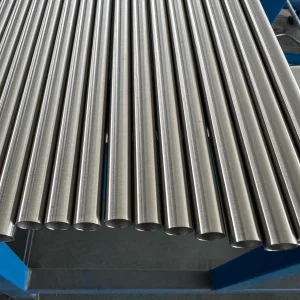





Executive Technical Whitepaper: Metallurgical Foundations of 310 Stainless Steel
Understanding the elevated temperature stability, phase transformation resistance, and oxidation mechanics of custom-fabricated AISI 310 / UNS S31000 tubing systems.
25Cr-20Ni High-Alloy Matrix
310 Stainless Steel is a heavily alloyed austenitic stainless steel engineered specifically for elevated temperature operations up to 1150°C (2100°F). The high chromium (24.0%–26.0%) and nickel (19.0%–22.0%) content imparts exceptional resistance to oxidation, carburization, and thermal fatigue, far exceeding conventional 304L and 316L grades.
Protective Oxide Kinetics
At high temperatures, Grade 310 forms a dense, adherent layer of chromium oxide ($Cr_2O_3$) scale on its surface. This protective film self-heals under continuous thermal cycling, preventing deeper oxygen penetration, spallation, and catastrophic metal loss in sulfur-bearing or oxidizing gaseous streams.
Creep Strength & Grain Control
By controlling grain size refinement during solution annealing, custom-manufactured Grade 310 pipes maintain structural integrity and stress-rupture strength under prolonged mechanical loads at temperatures exceeding 650°C (1200°F), mitigating thermal sagging in long-span furnace piping.
Comprehensive Metallurgical & Chemical Grade Comparison
Selecting the optimal variant (310, 310S, 310H, or 314) is essential to avoid embrittlement in specific operating temperature ranges. Below is a comparative analysis against standard industry benchmarks:
| Grade Designation | UNS / EN Standard | Cr (%) | Ni (%) | Carbon (%) | Max Temp (Air) | Key Performance Characteristics |
|---|---|---|---|---|---|---|
| Grade 310 | UNS S31000 / 1.4841 | 24.0 – 26.0 | 19.0 – 22.0 | 0.25 max | 1150°C (2100°F) | Standard high-temp alloy; high carbon provides superior hot-strength and creep rupture resistance. |
| Grade 310S | UNS S31008 / 1.4845 | 24.0 – 26.0 | 19.0 – 22.0 | 0.08 max | 1100°C (2010°F) | Low-carbon variant; mitigates carbide precipitation during welding for enhanced intergranular corrosion resistance. |
| Grade 310H | UNS S31009 / 1.4842 | 24.0 – 26.0 | 19.0 – 22.0 | 0.04 – 0.10 | 1150°C (2100°F) | Restricted carbon band optimized specifically for high-temperature pressure vessel and creep rupture applications. |
| Grade 314 | UNS S31400 / 1.4841 (Si) | 23.0 – 26.0 | 19.0 – 22.0 | 0.25 max | 1200°C (2190°F) | Silicon-boosted (1.5–2.5% Si) for extreme resistance to carburizing gases and high-temperature scaling. |
| Alloy 800H | UNS N08810 / 1.4958 | 19.0 – 23.0 | 30.0 – 35.0 | 0.05 – 0.10 | 1100°C (2010°F) | Nickel-iron-chromium base alloy offering resistance to nitriding and stress corrosion cracking. |
Custom Manufacturing Routes & Specification Capabilities
From heavy-wall seamless process pipes to high-precision thin-wall welded heat exchanger tubing, our custom production pathways are engineered to client tolerances.
Hot-Finished & Cold-Drawn Seamless
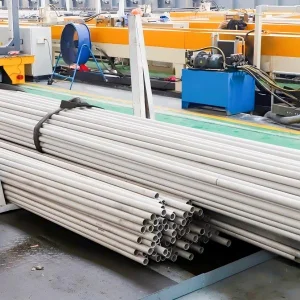
Extruded from solid pierces and cold-pilgered for maximum wall uniformity and grain refinement. Seamless 310 pipes are specified for extreme high-pressure thermal lines, steam superheaters, and hydro-processing systems operating under strict design codes (ASME SA312 / SA213).
Automated TIG/Plasma Welded Pipes
Utilizing high-purity strip raw material and continuous TIG / Laser / Plasma autogenous welding technology. Welded 310 pipes are subjected to 100% weld-bead conditioning, cold working, and full solution annealing to ensure the weld zone matches parent metal tensile and corrosion resistance.
Precision Bright Annealing & Heat Treatment
To eliminate $\sigma$-phase (sigma phase) embrittlement formed between 600°C and 900°C, all custom 310 pipes undergo solution annealing at 1040°C–1150°C followed by rapid water quenching or hydrogen atmosphere cooling, restoring ductility and corrosion resistance.
Technical Manufacturing Parameters at a Glance
- Outer Diameter (OD): 6.00 mm up to 610.00 mm (1/8" NB to 24" NB)
- Wall Thickness (WT): 0.50 mm to 30.00 mm (SCH 5S through SCH XXS)
- Supply Lengths: Single Random, Double Random, or Cut-to-Length up to 18 meters
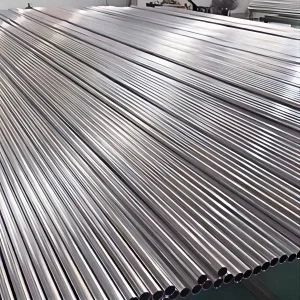
- Surface Finishes: Mill Pickled, Bright Annealed (BA), 180/320/400 Grit Polished
- Primary Standards: ASTM A312, ASTM A213, ASTM A269, ASTM A249, EN 10216-5, EN 10296-2
- Special Fabrication: U-bending, Finning, Swaging, Flanging, Custom Beveling
China Factory Supply Chain Advantages for Global Procurement
Why leading EPC contractors and multinational industrial buyers partner with China's top-tier 310 stainless steel pipe manufacturers for cost efficiency, scale, and uncompromising quality.
Upstream Raw Material Integration
By sourcing raw hollows and high-purity master heat coils directly from tier-1 steel mills (such as Tsingshan, Baosteel, and Yongxing), our factories guarantee precise 25Cr-20Ni chemistry control, low residual phosphorus/sulfur content, and complete melt-heat traceability.
Total Cost of Ownership (TCO) Optimization
Integrated manufacturing cluster infrastructure in Zhejiang and Jiangsu enables scalable production volumes, reduced overhead, and optimized cold-drawing costs. Global procurement managers achieve up to 25%–35% cost savings without compromising code compliance or metallurgical integrity.
Flexible MOQs & Rapid Lead-Time Predictability
State-of-the-art cold pilgering mills and multi-head automated welding lines support both quick-turn prototype batches and large-scale EPC project requirements, maintaining reliable dispatch schedules to major global ports within 15–30 days.
Global B2B Demand & Localized Application Scenarios
Custom 310 stainless steel pipes are critical components across high-temperature heavy industries worldwide. Here is where our products are actively deployed:
Industrial Furnaces & Heat Treatment
Radiant heating tubes, furnace muffles, conveyor rollers, thermal treatment retorts, and burner pipes subject to continuous flame impingement up to 1100°C.
Petrochemical & Ethylene Cracking
High-temperature pyrolyzer tube bundles, steam methane reformers (SMR), catalyst recovery piping, and flare tips handling corrosive hydrocarbons and hydrogen streams.
Power Generation & Boiler Superheaters
High-pressure steam superheater and reheater tubing coils operating in aggressive coal-fired, biomass, and waste-to-energy flue gas environments.
Cement Kilns & Glass Manufacturing
Kiln burner pipes, calciner thermal probes, glass melting tank cooling jackets, and clinker cooler ductwork requiring thermal expansion stability.
Quality Compliance, Certification & Localized Engineering Support
We eliminate international procurement risks through standardized quality control, comprehensive certification, and localized logistical and engineering assistance.
Full EN 10204 3.1 & 3.2 Traceability
Every shipment is accompanied by a certified Mill Test Report (MTC) detailing chemical heat analysis, mechanical tensile/yield properties, hardness, grain size, and intergranular corrosion testing (ASTM A262 Practice E). Independent 3.2 certification by SGS, TÜV, Lloyd's, or BV is available upon request.
Rigorous Non-Destructive Testing (NDT)
Our Quality Assurance lab executes 100% Non-Destructive Testing on all finished 310 pipes. Tests include Hydrostatic pressure testing up to 30 MPa, Eddy Current examination per ASTM A1016/E426, Radiographic Testing (RT) for welds, and Ultrasonic Testing (UT) for wall thickness verification.
Localized Global Delivery & Customs Support
We provide full-service export logistics including export-grade seawater-proof wooden crate packaging, bevel protection, end capping, and localized DDP (Delivered Duty Paid), FOB, or CIF shipping terms straight to customer job sites in North America, Europe, the Middle East, and Southeast Asia.
Industry Trends & Metallurgical Innovations in High-Temp Alloys
How decarbonization, hydrogen-blend combustion, and ultra-high-temperature waste heat recovery are shaping the next generation of custom 310 piping technology.
Hydrogen & Syngas Firing Compatibility
As industrial heating transitions toward green hydrogen blends, 310 stainless pipes are being subjected to higher moisture levels and severe hydrogen embrittlement risks. Advanced grain refinement techniques are being implemented to maintain microstructural resistance under pure $H_2$ combustion atmospheres.
High-Efficiency Waste Heat Recovery
Modern sustainability mandates require capturing energy from high-temperature exhaust flues. Custom 310 tubes with internal fins or modified surface textures enhance thermal transfer coefficients while enduring cyclic sulfidation and dust erosion.
Ultra-Clean VOD/AOD Melt Practices
Next-generation 310 manufacturing leverages secondary Vacuum Oxygen Decarburization (VOD) and Argon Oxygen Decarburization (AOD) refining, reducing trace tramp elements (Pb, Bi, Sn) to practically zero, substantially elevating high-temperature creep ductility.
Frequently Asked Questions (Technical Q&A)
Expert technical answers regarding design, selection, welding, and operational performance of custom 310 stainless steel pipes.
The main distinction lies in their carbon content. Grade 310 contains up to 0.25% Carbon, providing high creep strength for general thermal applications. Grade 310S is a low-carbon version (0.08% max C) designed specifically to minimize carbide precipitation during welding, making it ideal for heavy-wall welded constructions exposed to wet corrosive condensate during shutdowns. Grade 310H features a controlled carbon range (0.04%–0.10%) optimized for maximum high-temperature creep rupture strength under ASME pressure vessel codes.
When exposed to temperatures between 600°C and 900°C for extended periods, the iron-chromium matrix in 310 stainless steel can form a brittle intermetallic phase called Sigma ($\sigma$) phase, reducing room-temperature toughness. If equipment experiences thermal cycling or mechanical shock during maintenance shutdowns, full solution annealing (heating to 1040°C–1150°C followed by rapid water quenching) re-dissolves the sigma phase back into the austenitic solid solution.
When welding 310 stainless steel pipes to themselves, matching ER310 (bare wire) or E310 (covered electrodes) filler material is typically utilized. To prevent hot cracking (micro-fissuring) in fully austenitic weld metals, low heat input, controlled interpass temperatures (< 100°C), and stringer bead techniques are recommended. For joining 310 to carbon steel or dissimilar stainless grades, ERNiCr-3 (Inconel 82) or 309L filler metals can be specified.
Yes. Grade 310 has high ductility and formability similar to 304 and 316. However, due to higher work-hardening rates, bending equipment requires higher power. For tight-radius U-bends (R ≤ 2D), post-bend solution annealing is strongly recommended to relieve residual stresses and prevent premature stress corrosion cracking or high-temperature oxidation along the outer bend radius.
Grade 310 performs exceptionally well in oxidizing atmospheres up to 1150°C. In carburizing or reducing atmospheres, Grade 314 (high silicon modification) or Nickel Alloys such as Alloy 600 or Alloy 800H offer superior resistance. However, for moderate carburizing atmospheres containing sulfur, Grade 310's balanced 25Cr-20Ni composition often provides a more cost-effective solution than high-nickel alloys which are vulnerable to nickel-sulfide eutectic melting.
Explore additional precision manufactured tubing products tailored for critical corrosion and thermal environments.






Request a Custom Technical Quote & Specification Audit
Submit your project drawings, design codes (ASME/EN), wall thickness tolerances, and thermal requirements. Our metallurgical sales engineers will respond with detailed pricing and MTC documentation within 24 hours.
