
Featured Hydraulic & Pressure Pipe Series (Part I)
Engineered to exceed ASTM, ASME, and EN specifications for high-pressure hydraulic lines, heat exchangers, and chemical processing networks.



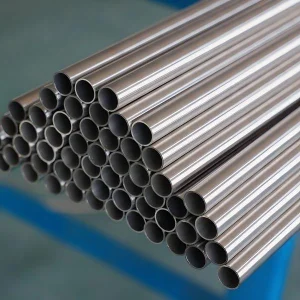




1. Executive Whitepaper: Global Industrial Fluid Power Landscape
Analyzing the macro-shift toward high-integrity, corrosion-resistant stainless steel hydraulic pipes across mission-critical heavy industrial sectors.
In modern industrial engineering, high-pressure fluid power systems serve as the structural vascular network of heavy machinery, marine propulsion, offshore oil extraction, aerospace test cells, and precision subsea actuation. Historically, carbon steel tubing dominated hydraulic applications due to initial cost advantages. However, as global industrial operations transition toward high-temperature, highly corrosive, and extreme-pressure operational envelopes, the total cost of ownership (TCO) model has overwhelmingly shifted preferences toward precision seamless and welded stainless steel hydraulic pipes.
Hydraulic fluid lines operate under cyclical impulse pressures, severe vibration, and ambient exposure to aggressive chemical media, salt fog, and extreme thermal gradients. The structural degradation of a hydraulic pipe—whether through pitting corrosion, hydrogen embrittlement, fatigue cracking, or inner-bore particulate contamination—inevitably leads to cataclysmic fluid power loss, costly un-planned outages, and environmental hazards. Consequently, Tier-1 original equipment manufacturers (OEMs) and EPC contractors demand hydraulic piping engineered with strictly controlled chemistry, precise wall concentricity, mirror-like inner surface smoothness (Ra < 0.4 µm), and certified mechanical strength.
Information Gain Metric: Standard commercial pipes often exhibit microscopic weld seams and wall thickness variations that induce fluid turbulence and fatigue failure under pulse-pressure regimes. Our factory utilizes multi-pass cold drawing and bright annealing in pure hydrogen atmospheres to eliminate inner wall inclusions, ensuring laminar flow dynamics and an extended operational lifespan exceeding 30 years.
2. Engineering Metallurgy & Precision Alloy Selection Matrix
Understanding the microstructural mechanics of Austenitic, Super Austenitic, Super Duplex, and Nickel Alloy hydraulic tubing.
Selecting the optimal stainless steel alloy for hydraulic piping requires balancing mechanical yield strength ($R_{p0.2}$), ultimate tensile strength ($R_m$), chloride stress corrosion cracking (SCC) resistance, and temperature limits. Below is a comprehensive engineering comparison of primary alloy families processed within our specialized manufacturing plant.
| Steel Grade & Designation | Microstructure | PREN Value | Yield Strength (MPa) | Primary Industrial Application |
|---|---|---|---|---|
| 304L / 1.4307 (UNS S30403) | Austenitic | ~19 | ≥ 210 | Standard industrial fluid lines, food process hydraulics |
| 316L / 1.4404 (UNS S31603) | Mo-Austenitic | ~25 | ≥ 240 | Marine hydraulics, chemical plant fluid power, instrumentation |
| 321H / 1.4878 (UNS S32109) | Ti-Stabilized Austenitic | ~20 | ≥ 220 | High-temperature hydraulic loops, refinery actuators (≤ 800°C) |
| 310S / 1.4845 (UNS S31008) | High Cr-Ni Austenitic | ~27 | ≥ 205 | Thermal process control, extreme furnace fluid lines |
| 904L / 1.4539 (UNS N08904) | Super Austenitic (4.5% Mo) | ~36 | ≥ 230 | Sulfuric acid processing, brackish water hydraulic systems |
| 254SMO / 1.4547 (UNS S31254) | 6% Mo Super Austenitic | ≥ 43 | ≥ 300 | Offshore platform hydraulics, flue-gas scrubber control |
| Super Duplex 2507 / 1.4410 | Ferritic-Austenitic (50/50) | ≥ 42 | ≥ 550 | Subsea umbilicals, high-pressure marine hydraulics (> 500 bar) |
| Incoloy 800HT / 1.4959 | Nickel-Iron-Chromium Alloy | N/A | ≥ 170 | Petrochemical high-temperature cracking unit control lines |
Technical Calculation Formulae for Pipe Sizing
When specifying wall thickness for high-pressure seamless hydraulic pipes, design engineers must calculate internal bursting pressure utilizing modified Lamé formulas or Barlow’s Formula:
Barlow's Pressure Formula: $P = \frac{2 \cdot S \cdot t}{D_o} \cdot E \cdot F$
Where: P = Working Pressure (PSI/Bar), S = Allowable Stress (2/3 of Yield Strength $R_{p0.2}$), t = Nominal Wall Thickness (mm), D_o = Outside Diameter (mm), E = Longitudinal Joint Efficiency (1.0 for seamless), F = Design Safety Factor (typically 0.25 to 0.4 for hydraulic impulses).
By utilizing high-yield materials such as Super Duplex 2507 (S32750), engineers can reduce wall thickness by up to 40% compared to conventional 316L tubing without sacrificing working pressure. This yields significant weight reductions for offshore topside structures and mobile aerospace ground hydraulics.
3. Precision Manufacturing Route & Quality Control Blueprint
How our state-of-the-art factory converts raw premium hollows into zero-defect hydraulic piping.
1. Raw Material Verification
Every heat of raw stainless hollow or strip undergoes full spectral PMIs, ultrasonic flaw detection, and chemistry verification to eliminate tramp elements prior to cold working.
2. Cold Pilgering & Drawing
Multi-pass cold reduction on high-precision pilger mills achieves exact outer diameter (OD) and wall thickness (WT) tolerances down to ±0.05 mm, refining the internal grain structure.
3. Hydrogen Bright Annealing
Heat treatment in a controlled pure hydrogen atmosphere at temperatures up to 1080°C relieves cold-work stresses without causing oxide scale formation, guaranteeing a mirror surface finish.
4. Bore Flushing & Passivation
Internal bore surfaces are subjected to ultrasonic solvent flushing, high-pressure air drying, and chemical passivation to guarantee ISO 4406 particulate cleanliness codes of 15/13/10 or cleaner.
5. Full Spectrum NDT & Hydrotest
100% of finished pipes undergo inline Eddy Current testing (ASTM E426) and hydrostatic pressure testing up to 1000 Bar to guarantee total structural tightness prior to bundling.
4. Macro Industry Solutions & Regional Application Scenarios
Deployment of specialized stainless hydraulic lines across global industrial sectors.
Subsea Oil & Gas Umbilicals
Deployed in North Sea, Gulf of Mexico, and Brazil Santos Basin subsea manifolds. Utilizing Super Duplex 2507 and UNS S31254 (254SMO) hydraulic lines engineered to withstand external hydrostatic pressures at 3,000m depth and internal sour gas ($H_2S$) concentrations compliant with NACE MR0175.
Aerospace Ground Support Equipment (AGE)
Supplying ultra-clean ASME SA213 TP304H and TP321H hydraulic lines for rocket launchpad hydraulic actuators, jet engine test beds, and military aircraft ground refueling systems requiring zero fluid contamination.
Heavy Machinery & Mobile Hydraulics
Providing precision bent and straight ASME SA312 TP304L/TP316L hydraulic lines to European and Asian OEM construction equipment manufacturers for mega-excavators, tunnel boring machines (TBMs), and mobile harbor cranes operating under intense cyclical shock loads.
Semiconductor & Ultra-Pure Cleanroom Lines
Electropolished (EP) UNS S31603 hydraulic lines specified for high-purity fluid delivery systems in semiconductor fabrication plants across East Asia and North America, featuring surface roughness $R_a \le 0.13 \, \mu m$.
5. Localized Regulatory Compliance & Quality Assurance
Meeting regional standards and certification protocols for seamless international procurement.
Global engineering projects demand strict adherence to regional regulatory frameworks and mill test standardizations. Our manufacturing operations maintain full compliance with major global regulatory standards, providing standardized **EN 10204 3.1** mill test certificates with every shipment, as well as **EN 10204 3.2** independent third-party verification (DNV, Lloyd's Register, TÜV, ABS) upon customer request.
North American Standards
ASTM A213 / A269 / A312 / ASME SA213 / SA312: Strict compliance with dimensional tolerances, hydrostatic testing limits, and grain size specifications mandated by US pressure vessel codes (ASME Section VIII).
European Union Directives
EN 10216-5 / EN 10217-7 / PED 2014/68/EU: Full Pressure Equipment Directive certification allowing seamless integration into EU power plants, chemical refineries, and machinery installations.
SORS & NACE Sour Service
NACE MR0175 / ISO 15156: Hardness testing (< 22 HRC) and microstructural control to guarantee immunity to Sulfide Stress Cracking (SSC) in sour gas hydraulic environments.
6. Technical Roadmap & Future Engineering Outlook (2025–2035)
Pioneering next-generation hydraulic piping solutions for hydrogen fluid power, smart monitoring, and extreme environmental durability.
Developing specialized nickel-stabilized austenitic stainless pipes designed to eliminate hydrogen embrittlement under extreme 870 Bar refueling pressures for heavy transport systems.
Integrating micro-grooved hydraulic pipes embedded with fiber-optic strain and acoustic emission sensors for real-time fatigue monitoring and predictive maintenance in subsea manifolds.
Pioneering nano-grain refinement techniques in cold-drawn duplex tubing to achieve yield strengths exceeding 800 MPa while maintaining superior ductility and impact toughness at cryogenic temperatures (-196°C).
Featured Hydraulic & Pressure Pipe Series (Part II)
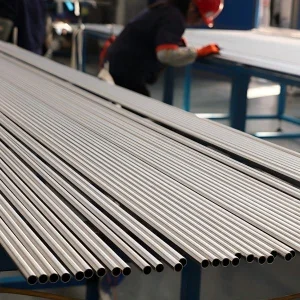
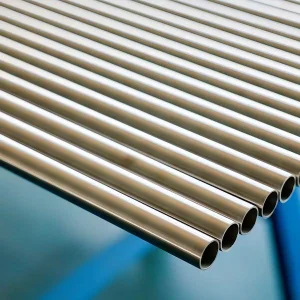
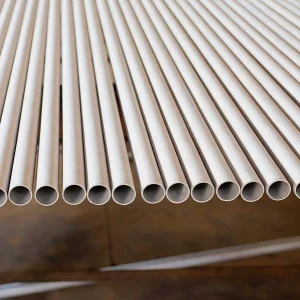
Explore our complete catalog of precision engineered stainless steel, super austenitic, super duplex, and nickel alloy tubing products.





7. Comprehensive Technical Q&A (Frequently Asked Questions)
Expert engineering answers regarding procurement, quality verification, and field performance.
